


Two weeks ago, I published The Full Banking Setup For Moving Abroad.
The final takeaway was one sentence:
“Open every account before you leave.”
That was advice from experience.
This week’s article shows why.
On January 11, 2027, a new EU banking rule called CRD VI takes effect.
From that day, a bank headquartered outside the EU can’t take deposits from you or lend to you while you live in the EU, unless it has a licensed branch in the country you live in.
The rule looks at where you live:
A retired American in Lisbon lives inside the EU, so every non-EU bank she uses falls under the rule.
The same American, still in Ohio, lives outside the EU, so her banking is none of the EU’s business, no matter what she opens or where.
Very important nuance:
The rule targets banks, not you.
No account becomes illegal, and no money gets taken from anyone.
The question it creates is which banks will still have you as a client once you’re an EU resident.
So if you plan to retire in France, Portugal, Spain, Italy or Greece, and you want part of your money outside the EU (your US accounts, or an account in Switzerland, Singapore, Panama or the Caribbean), the order you do things in is now more important than ever.
Why?
Because while you still live in the US, you are not an EU resident yet.
Banks can take you on, and this rule has nothing to say about it.
The day you register as a resident in the EU, you become the person this rule covers.
From that day, a bank outside the EU needs a licensed branch in the country you live in.
But there are few exceptions we’ll get to later in this article.
Here’s what we’ll cover today:
What the EU decided, and who it applies to from January 11, 2027
The two exceptions written into the law, and why one of them closed on July 11, 2026
What to do if you’re moving in 2027, and what to do if you already live in the EU
We start with the rule itself.
What the EU decided
In May 2024, the EU adopted the sixth version of its main banking law, the Capital Requirements Directive, known as CRD VI.
For you, the whole law comes down to one article inside it:
Article 21c.
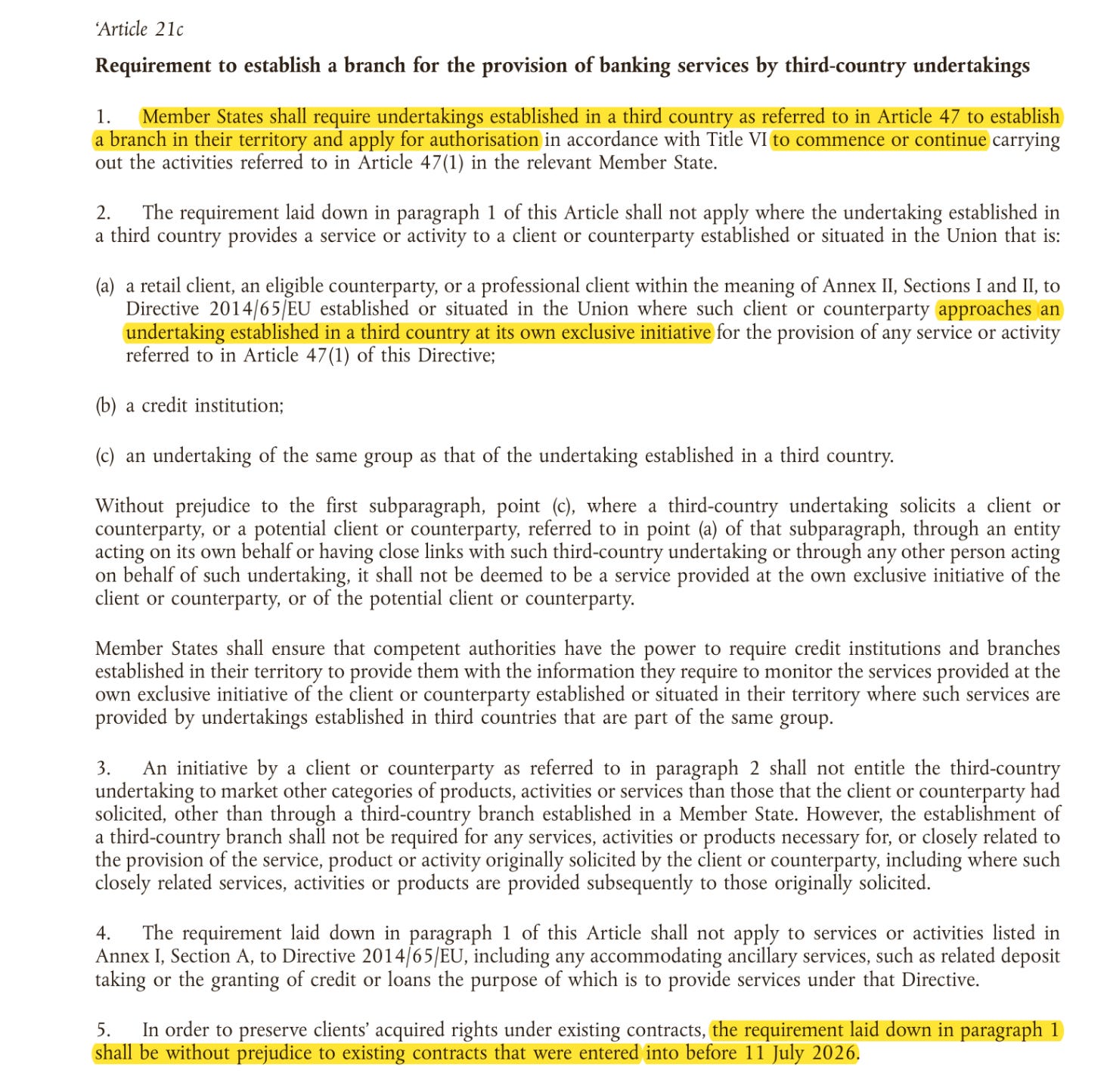
It says that a bank headquartered outside the EU must open a licensed branch in an EU country before it can provide “core banking services” to people living there.
Core banking services means three things:
Taking deposits
Lending (including consumer loans and mortgages)
Issuing guarantees (e.g. the bank promising a landlord they'll get paid)
In plain terms:
Holding your money and lending you money.
What the rule does not cover matters just as much.
Investment services are excluded.
Your brokerage account and your managed portfolio fall under a different EU law (MiFID), with its own regime for foreign firms.
Nothing in this article applies to them, so keep the two questions separate.
The rule applies in all 27 EU countries.
Norway, Iceland and Liechtenstein agreed in March 2026 to adopt it as well, and it takes effect there once their national procedures finish.
Now, the part I find remarkable (but not surprising):
EU countries had until January 10, 2026 to write this rule into their national law.
Only five of them made the deadline.
In March 2026, the European Commission opened infringement proceedings against the other 22.
By August, twelve countries had finished the job.
EU countries are known for having extensive summer holidays. Combine that with ancient bureaucracy, and you understand why I’m not surprised.

None of that changes your date.
The rule applies from January 11, 2027 everywhere, finished paperwork or not.
What will banks do about it?
A bank that wants EU-resident clients has three options:
Open a branch in every country where its clients live
Move those clients to a subsidiary inside the EU
Fit them into the exceptions written into the law
Skadden, a law firm advising US banks on this rule, expects most banks to use subsidiaries and exceptions.
Almost nobody opens branches in ten countries for a handful of retail clients.
Those exceptions are your options, so that’s where we go next.
Takeaway: From January 11, 2027, a non-EU bank needs an EU branch, an EU subsidiary, or one of the law’s exceptions to hold your deposits once you live in the EU.
The two exceptions
Exception one:
Grandfathering.
Contracts signed before July 11, 2026 keep working as they are. The bank can service them across the border, no branch needed.
Two things here, before you get overly excited about it.
First, the date already passed. If you signed before it, you’re protected. Nobody can get this protection anymore.
Second, the protection covers the contract as it stands, not the relationship. Law firms advising banks warn that material changes can break it. For example, extending a loan’s term, drawing additional credit or turning the product into something else. The safe assumption is that a grandfathered contract stays grandfathered for as long as you leave it alone.
Why did this window close six months before the rule even starts?
Because the EU published all three dates back in 2024.
If protection had run until January 2027, every non-EU bank would have spent late 2026 signing up EU clients as fast as possible to lock them in.
The lawmakers saw that coming and closed the window early.
The directive says transition measures must be framed narrowly “to avoid instances of circumvention.”
Exception two:
Reverse solicitation.
When you approach a non-EU bank at your “own exclusive initiative,” the bank may serve you without a branch.
It comes with three conditions:
The initiative must be entirely yours. If an agent the bank pays brought you in, the law says that no longer counts as your initiative.
The bank has to prove it. Regulators can demand records, so the bank keeps proof on file that the request came from you.
It doesn’t extend to new products. The bank can keep providing what you asked for, but it may not market new product categories to you.
And here is what separates this exception from grandfathering: the bank decides whether to use it.
The exemption sits with the bank’s compliance department, not with you.
Some banks will rely on it for their EU-resident clients and keep the files. Others will decide the paperwork isn’t worth a few retail clients and decline.
A real case from my client work:
An American living in Greece opened an account at a non-EU bank in August 2026.
Grandfathering doesn’t cover her, since the date had passed a month earlier.
Reverse solicitation does, since she requested the account herself, in writing, and the bank onboarded her knowing where she lives.
From January 2027, the bank can keep serving her on that basis for as long as it’s willing to keep the file.
Takeaway: Grandfathering is closed to new contracts, and reverse solicitation belongs to the bank, so the only protection you fully control is opening your accounts before you become an EU resident.
What to do now
Three situations.
1. You’re moving to the EU in 2027 or later.
Open every non-EU account you want before you register as a resident.
The US accounts, the fintech accounts, the account in a third country.
All of it.
As a US resident, you’re a normal customer everywhere in the world. No exemption needed, no compliance file, nothing to document.
One extra step I now build into this:
Ask the bank (in writing, via email is fine) how it treats clients who later become EU residents.
How a bank behaves after you move is its policy decision, and you want its answer in your file before you move, not a surprise after.
2. You already live in the EU, with accounts opened before July 11, 2026.
Don’t touch them.
Grandfathering protects the contract as it stands.
Closing and reopening, upgrading to a different account type, extending a loan: each of those can turn a protected contract into an unprotected one.
If you need a change, ask the bank first how it affects your grandfathered status (again, in writing, always).
3. You already live in the EU, and you want a non-EU account now.
Reverse solicitation is your path.
The law sets one condition:
The initiative must be yours.
That means you decided you want the account, and nobody selling for a bank talked you into it.
You can contact a bank directly, or you can hire someone to find the right bank and handle the whole application for you.
And here the law hands you a useful test for anyone you might hire.
If an adviser is paid by the bank for bringing you in (a referral fee, an introducer agreement, a commission), the law says your request no longer counts as your own initiative.
The exemption is then invalid, and the bank can’t take you.
An adviser paid only by you leaves the exemption intact.
So ask one question before you hire anyone:
“Does any money flow to you from the bank?”
I also got this question from people, and my answer is always the same:
“I don’t take referral fees from banks, because it would compromise my neutrality.”
Expect some banks to decline anyway.
I had cases that were harder than others, but I always find a way to open an account for my clients.
Here is one of them (Wendy), speaking about her experience with her offshore account opening with me (full case study coming soon):
Takeaway: Open accounts before you register as an EU resident, leave grandfathered contracts alone, and put every request to a bank in writing.
Conclusion
That’s it.
The whole rule:
From January 11, 2027, a bank outside the EU needs a licensed branch, an EU subsidiary, or one of the two exceptions to hold deposits for EU residents.
Grandfathering closed on July 11, 2026, and reverse solicitation belongs to the bank’s compliance department, not to you.
Your residence date is the one lever you fully control: open your non-EU accounts before you register, and the rule never applies to the account opening.
One thing to do this week:
If a move to Europe is anywhere in your next three years, write down which non-EU accounts you want, and start opening them while you still live in the US.
Appreciate having you here,
— Ben
PS
If you want an offshore account, this is the work I do with clients. And if Europe is in your plans, the timing above is worth a conversation before you register anywhere.
Book a call and bring your questions.
And feel free to make the first question:
“Does any money flow to you from the bank?”
(You already know my answer.)