


Of all the Mediterranean countries Americans retire to, Greece has the highest income requirement.
Portugal’s D7 lets a single applicant in on €920 a month.
Spain’s non-lucrative visa requires €2,400, and France’s long-stay visitor visa sits between the two.
Greece requires €3,500 a month in passive income, plus 20% on top if your spouse comes with you.
I still like Greece despite the higher threshold, because of its tax regime:
7% flat on foreign income for 15 years.
Italy has a similar deal, but only if you settle in a southern village of under 30,000 people.
I’ve only been to Greece once (to Athens), and lived in the Greek part of Cyprus for a year.
I loved Athens, and also tried to learn Greek for a few months, but can’t reproduce much more than the occasional “Kalimera” by now.

This guide has two angles.
First, I want to talk about the paths and requirements, and who Greece makes sense for.
Second, I want to talk about the tax deal, and how it compares to the other ones European countries offer.
Along the way I will look at 1) the income definition from the September 2024 ministerial decision, 2) the savings-account “fallback” if your income falls short, and 3) what a tax treaty signed in 1950 fails to cover.
Here’s what we’ll cover today:
What the FIP visa requires in 2026 and how the application works
When the golden visa makes more sense, plus the family route
How healthcare and the 7% flat tax work once you hold the card
First, who this guide is for.
Why Greece and who this guide is for
Greece is a good choice if you want Mediterranean life on your own income, with an attractive tax deal attached.
The main residency route requires stable passive income.
What qualifies as passive income are the following:
Social Security, pensions, IRA distributions, dividends, rental income.
There is no need for a job offer (work is not allowed on the main retiree route), and you don’t need to buy property (unless you go for the golden visa).
Who this guide helps:
You are retired (or close) and live on a pension or Social Security.
You are financially independent and fund your life from savings or investments.
You work remotely and want to know which Greek route covers that.
You own or want a vacation place in Greece and keep hitting the 90-day Schengen wall.
Your spouse or partner is Greek or holds Greek residency.
You have wanted to live in Greece for years and want to know what it takes.
One more group deserves a mention: if you have a Greek parent or grandparent, you may have a citizenship claim by descent.
The citizenship by descent path will not be covered in this article.
What you will get:
A map of the routes that fit the situations above.
The status each route leads to and what it lets you do.
Typical timelines and costs, plus the traps that show up in practice.
Official links so you can verify every step.
What to know up front:
Rules change and consulates differ, always check the latest updates (if you comment with updates in three months, this article will be updated too).
Confirm the details with your consulate or a Greek immigration lawyer before you act.
Next, some vocabulary, because Greek paperwork has its own names for everything.
The permits
An American can be in Greece two ways:
As a tourist
As a resident
Tourists get 90 visa-free days per 180, and those days can’t be turned into residency from inside Greece (one exception, at the end of this section).
Becoming a resident follows a sequence, and this is it:
Step 1: the type D national visa.
The long-stay entry visa, issued by the Greek consulate covering your US state, before you move.
You apply for it under a specific route (e.g. FIP, Digital Nomad visa), and the consulate will ask you for the same evidence as that route’s evidence.
To make this a little bit easier to understand:
Person A applies for the type D, and wants the FIP visa after. To get the type D, Person A shows the evidence needed to get the FIP.
Person B applies for the type D, and wants a Digital Nomad Visa after. To get the type D, Person B shows the evidence needed to get the Digital Nomad visa.
Basically the type D is the “middle step” for any type of visa that comes after.
Makes sense?
The consulate issues the type D for up to a year, and it lets you live in Greece that whole time (unlike a tourist stamp).
Step 2: the AFM.
Your Greek tax number, and you need it no matter which route you take.
Greece requires an AFM on almost any contract you sign there: the apartment lease that becomes your proof of accommodation in step 3, and the bank account you’ll pay rent from.
The AFM has nothing to do with your immigration status and anyone can get one (even a tourist buying a holiday house).
You might ask:
Why is it so easy to get a tax number?
To which I would say:
Well, who benefits from you getting a tax number?
… Exactly.
The tax number is not a bottleneck, so you can get it after you land.
Step 3: the residence permit application, and the blue certificate.
While your type D is still valid, you file for the residence permit (άδεια διαμονής), the card you’ll actually live on.
The moment you file, you get the blue certificate (βεβαίωση), a receipt that keeps you legal while the ministry decides, which can take months.
Step 4: the card.
The FIP card is valid for three years at a time; the golden visa card for five.
And if you complete step 1 but never file for the card, nothing dramatic happens: the visa expires, and you’ve paid consulate fees for a long test run.
The exception: the golden visa does not need step 1.
Investors can enter on tourist status and file for their card from inside Greece.
Still with me?
Route = what your plan is (retire, invest, work)
Type D visa = middle layer (don’t need it for golden visa)
AFM = tax number (not a bottleneck)
Blue certificate = receipt showing you applied for residence permit
Residence permit = what you want at the end, “the card” (e.g. FIP card)
Now, the most popular route called the “Financial Independence Person Visa” (or short, FIP).
Route 1: the FIP visa
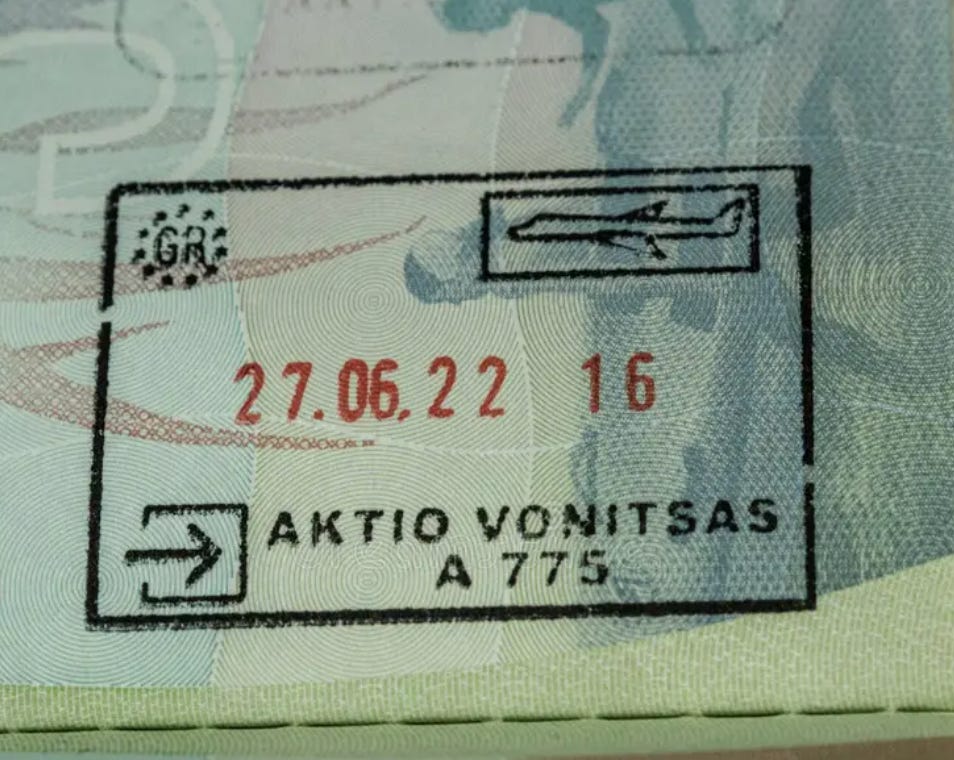
This is the retiree route, and the main event of this article.
This is part of a series, check out the others:
How U.S. Citizens Can Move to Germany (Blue Card vs. Freelance Visa)
How U.S. Citizens Can Move to Malta (Residency & EU Access Explained)
How U.S. Citizens Can Move to Ireland (Residency & Citizenship Explained)
How U.S. Citizens Can Move to the UK (Residency & Citizenship Explained)
How U.S. Citizens Can Move to France (Residency & Citizenship Explained)
How U.S. Citizens Can Move to Canada (Residency & Citizenship Explained)
How U.S. Citizens Can Move to Mexico (Temporary Residency Step-by-Step)