


On April 17, the Paraguayan government launched the Investor Pass.

The brand new residency-by-investment program has three tracks, each one including direct permanent residency from day one.
The tracks are:
Invest $200K in securities.
Invest $200K in real estate.
Invest $150K in tourism projects.
Total residency applications already went from 28,000 in 2024 to 47,000 in 2025, with 80,000 projected for 2026.
For Americans looking south of Mexico, this is the biggest residency-by-investment launch in Latin America this year.
I spent a few hours pulling it apart.
What the announcement doesn’t say and what you need to understand before making a decision.
Here’s what we’ll cover:
What the Investor Pass actually buys you, and what it doesn’t
Why the territorial tax structure matters more than the residency
Which of the three tracks makes sense, and which one I would avoid
Let’s start.
What the Investor Pass actually buys you
In short:
A Paraguayan permanent residency card, granted directly.
(Without the two-year temporary stage like the older programs required under Law 6984/22).
For those of you who are familiar with Paraguay, you might know that there is one other route that avoids that two-year wait.
The SUACE Business Plan, in place since 2022, granted direct permanent residency for $70,000 invested in a Paraguayan company, plus a business plan and five local hires.
The Investor Pass removes the business and hiring obligations entirely.
Once you allocate capital under one of the three tracks you receive permanent residency.
The trade-off is a higher capital threshold: $150K-200K instead of $70K.
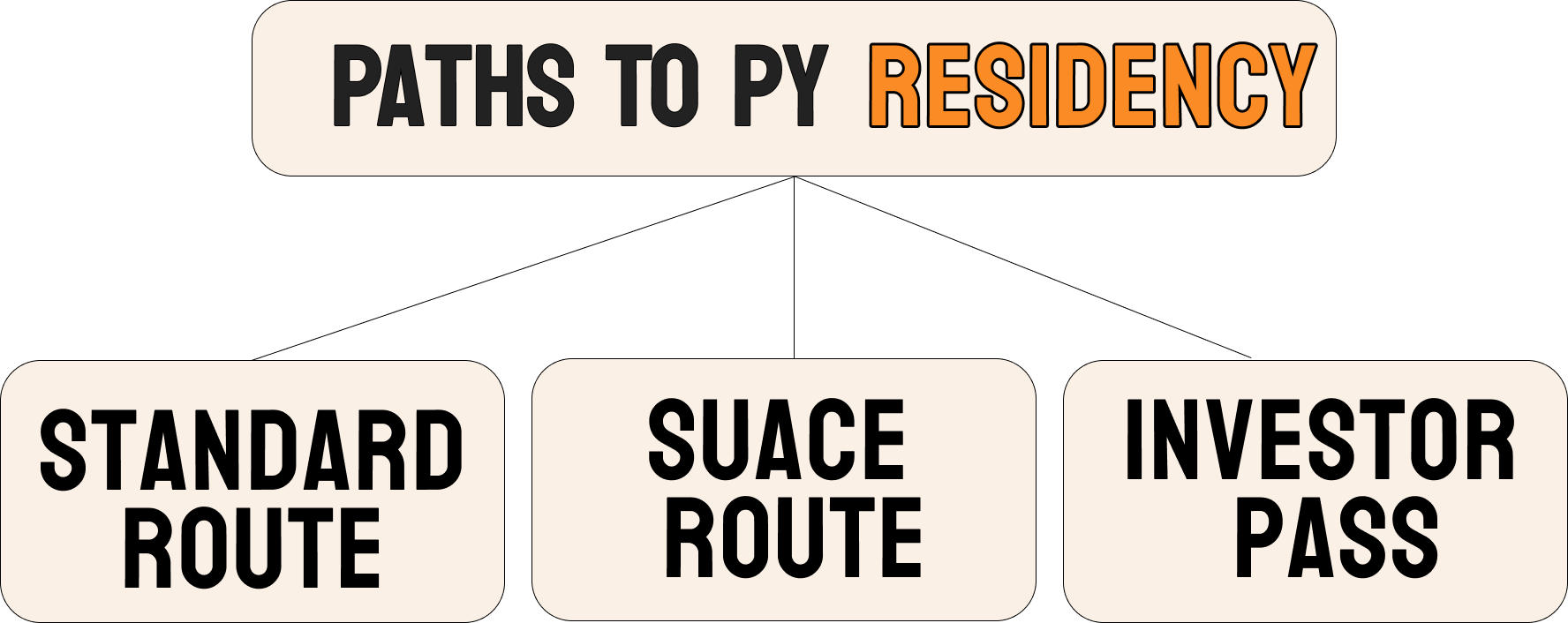
So as of April 2026, you have three paths to Paraguayan permanent residency:
The standard route (slow but cheap, no investment, two-year temporary stage, then permanent).
The SUACE Business Plan ($70K plus running a real business with five employees).
The Investor Pass (fast, passive, $150K-200K, no operating obligations).
The benefits of the Investor Pass:
Permanent residency from day one
Citizenship eligible after three years of permanent residency
One entry to Paraguay every three years keeps your status active
That citizenship benefit has a condition I will cover in a later section.
What the Investor Pass does not do automatically: make you a tax resident of Paraguay. The pass gives you a “cédula”, which is the prerequisite for opening a bank account and registering for a RUC (tax ID) through SET, the tax authority.
The RUC is what makes you a taxpayer.
Without it, Paraguay is your home for immigration purposes but not for tax purposes.
The tax residency certificate (the document you would actually show another government to prove where you pay tax) is a separate application on top of all that.
Takeaway: The Investor Pass shortens the residency process from two steps to one. Tax benefits are not (automatically) linked to obtaining the PR.
Why the territorial tax structure matters more than the residency
Paraguay has a territorial tax system. Foreign income is taxed at 0%.
For an American retiree drawing a 401(k), Social Security, or dividends from a US brokerage, Paraguay doesn’t touch any of it.
There is no wealth tax and no inheritance tax and local income gets taxed at a flat 10%.
If you’ve been looking at Europe, you know how rare clean tax setups are becoming.
Spain taxes pension income at rates up to 47%.
Portugal’s NHR closed to new applicants in 2024 and its replacement excludes pensioners.
Italy’s flat-tax regime for new residents now costs €300,000 per year.
Paraguay has no cap, no expiration, and no exclusion for pension income.
I know what you’re thinking.
“That sounds great Ben, but it’s Paraguay. I want to spend my retirement in Portugal.”
Fair.
But you don’t have to live in Paraguay to benefit from the tax system.
There are ways to structure your global setup so that you hold a territorial tax residency in a country like Paraguay or Panama, while spending months per year in Italy, Spain, or Portugal without triggering tax residency there.
In a safe structure, you keep the US obligations, add nothing on top, and live where you actually want to live. It takes careful structuring. The 183-day rule, center-of-life tests, and treaty provisions all need to line up. That’s what I work through with clients in the Retire Abroad Blueprint.
One reminder:
Territorial taxation abroad does not replace your US obligations. You are still American. Paraguay eliminates the second tax layer that a country like Spain would add on top. If you haven’t read my full breakdown of how US taxes work when you retire abroad, start there.
Takeaway: Paraguay’s territorial tax system is a great option, and you don’t have to live there full-time to use it.
If you’re thinking about retiring abroad in the next 5 years but not sure about where to go, which visa to use, or what happens to your money when you leave, you can book a free call with me here. Or reply with "Call" and I will reach out.
Which of the three tracks makes sense, and which one I would avoid
Not all $150-200K options carry the same risk. Here is how I view the three present options.