


Many people still think moving abroad is a single decision.
And that there is a single path that is “the best”.
But there is more than one path.
Retiring abroad is a series of smaller decisions that add up to a lifestyle.
Where you live.
How long you stay.
Whether you keep a home base or let go entirely.
These choices matter just as much as the country you pick.
Some alternate between two or more destinations.
Others plant roots in one country and never look back.
Some split the year between the US and a summer home.
And some mix it up in even different ways.
All of them “retired abroad.”
But they are living completely different lives.
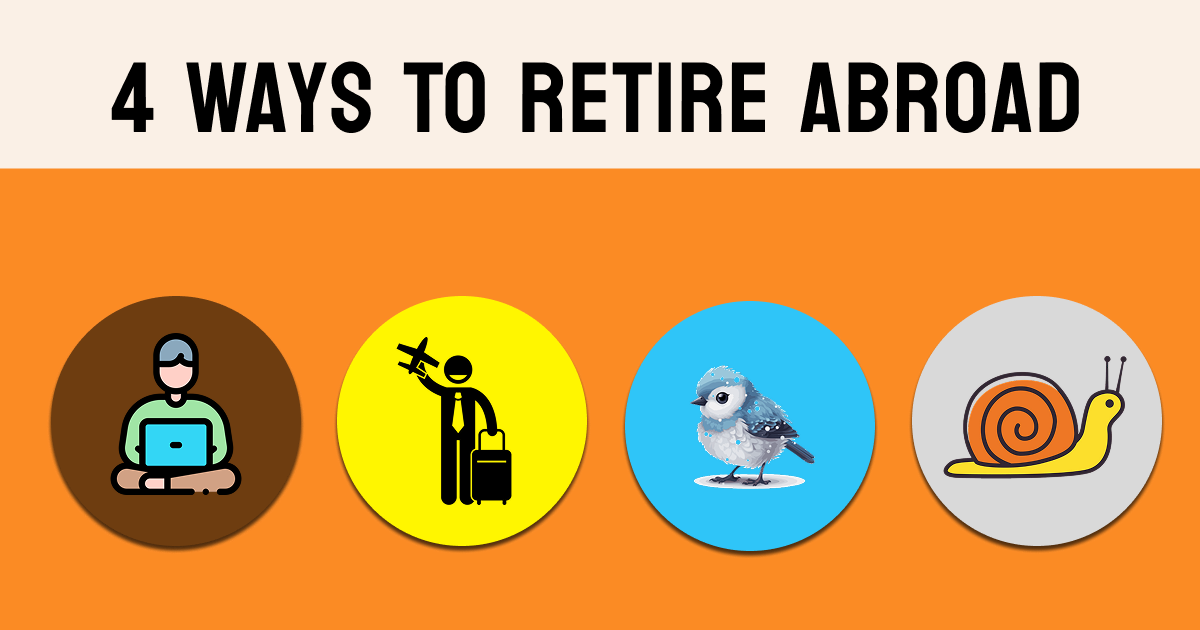
Today we’re breaking down the 4 main strategies:
“Expat”: You move abroad and one country becomes your new home.
“Snowbird”: You split time between two places, usually depending on weather.
“Slowmad”: You rotate through a handful of countries, staying months at a time.
“Nomad”: You keep moving in even shorter intervals, with short or long stays.
None of these is “better” than the others.
But one of them probably fits your life better than the rest.
#1 Expat

You pick one country and stay.
Get a residency visa.
Sign a lease.
Open a bank account.
(Figure out which grocery store doesn’t rip you off.)
This fits people who want stability.
You want a doctor who knows your history, a coffee shop where they remember your order and make friends with neighbors you’ll see every month.
But here’s where people mess up.
They vacation somewhere for two weeks, fall in love with the place, and start shopping for apartments.
The problem is, two weeks doesn’t tell you much.
You need 60 to 90 days minimum.
Does the charm hold when you’re waiting three hours at the foreign registration office?
When it rains for 19 days straight in January?
The Advantages Of Being An “Expat”
You build something.
Routines, relationships, local knowledge. This lifestyle is less “transient” than others.More access.
In some countries, residency gives you access to public healthcare, also things like property purchases become easier.Citizenship is easier.
Depending on the residency type, the path to citizenship becomes more accessible as well.
The Disadvantages Of Being An “Expat”
You’re a tax resident.
One tax system, whatever they throw at you. Take Portugal, who eliminated NHR in 2024.More exposure.
If the economy tanks, the currency drops, or the government shifts, you’re exposed.Pivoting is expensive.
You built a life, maybe bought property. Walking away costs money, time, and relationships.
Questions To Ask Yourself
Have I spent at least 60-90 days here outside of vacation mode?
Do I know what happens if I change my mind in three years?
Do I have healthcare figured out beyond age 50?
Takeaway: Expat life is a trade-off between flexibility and depth. One country, one community, one bureaucracy to master.
#2 Snowbird

You split the year between two places.
Keep your home base.
Add a second location.
Fly back and forth with the seasons.
The “classic” version: Americans who escape US winters for Mexico or Costa Rica.
Or Europeans who fly out in November to their finca in Spain, and return in March when the sun comes out again.
It also works the other way around, as I did in the UAE, to escape the brutal heat between June and August.
You keep:
Your house
Your doctors
Your community
Snowbirding lets you “test” retirement abroad without betting everything on it.
The Advantages Of Being A “Snowbird”
Easy exit.
If you don’t like the place, you pick another one next time.Low commitment.
Depending on the visa policy, you’re most likely a tourist, not a resident. Less paperwork headache.Keep your healthcare intact.
Medicare doesn’t work abroad, but you’re only gone a few months.
The Disadvantages Of Being A “Snowbird”
Flights add up.
Two to four roundtrips per year. Peak season pricing if you’re chasing weather.Two sets of expenses.
Rent or mortgage in both places. Utilities running whether you’re there or not.You never “fully” integrate.
Few months isn’t enough to build real community. You’re always the visitor.
One Decision You Will Face
Buy or rent?
First question: Can you even buy?
Some countries require residency, or don’t allow foreign ownership (or only condos and not land, as the case e.g. in Thailand).
If you can buy, you are now a foreign property owner.
That means local property taxes, and capital gains when you sell. Not to forget the reporting requirements to the IRS.
Then there’s the empty months.
For several months per year, your place is vacant and need someone checking on it.
Or you rent it out, which means property management, local rental taxes, and wear and tear from strangers.
Renting keeps it simpler.
But you might be subject to peak season demand, and you can’t leave things behind, which means packing and travel will be more stressful.
Questions To Ask Yourself
Can I afford two households?
Am I okay being a permanent visitor?
Do I have the energy for 2-4 international trips per year?
Takeaway: Snowbirding lets you test retirement abroad without giving up your home base. You stay connected, keep your healthcare, avoid tax residency abroad.
But you are paying for two households.
#3 Slowmad

Now we’re in different territory.
Expats and snowbirds keep a home base to return to.
A place with their name on the mailbox.
Slowmads don’t.
You rotate through a handful of countries on repeat. Three months here, three months there, back around again.
Slowmads rent everywhere.
Furnished apartments, Airbnbs, longer-term sublets.
You arrive with your bags, you leave with your bags.
This fits people who haven’t found a single place they want to commit to.
Or people who know they never will.
The Advantages Of Being A “Slowmad”
You get used to it.
Each place becomes more familiar after a few rotations.No single government “owns” you.
If there are policy changes in 1 country you got 2-3 other spots.Less tax hassle.
Stay under 183 days per country and you might not trigger tax residency anywhere.
The Disadvantages Of Being A “Slowmad”
Logistics never stop.
Flights, visas, apartments, SIM cards, every few months.You are always leaving.
From personal experience I can say, that “real” friendships are formed easier as an Expat.No stable healthcare system.
You need international insurance that works across every country you rotate through.
Questions To Ask Yourself
Do I have the energy for this?
What’s my plan for healthcare?
Where do I want to be if I get too sick to travel for six months?
Takeaway: Slowmads are rotating a lot. Variety, potential tax advantages, freedom from any single government. But healthcare needs to be thought through, and everything you own has to fit in one (or 2) suitcases.
#4 Nomad

Slowmads have three or four places they return to.
Nomads don’t even (necessarily) have that.
You keep moving. No set pattern. No anchor anywhere.
This does not mean nomads can’t stay in one place for months at the time.
But the overall nature of nomads is less fixed on rotating between pre-decided countries/cities, as e.g. in the case of Slowmads.
This is the most extreme version of retirement abroad.
It fits a specific kind of person.
I was that person for a year.
It was fun, it was exciting, and it was exhausting. But the memories I made were priceless.
Also, I just turned 30, so my energy level was limitless.
The Advantages Of Being A “Nomad”
Visa flexibility.
Since stays are short, visas are easier to get.Total freedom.
No lease, no schedule except the one you make.See more of the world.
You hear about a place, you go. Curious about Tanzania? Book a flight.
The Disadvantages Of Being A “Nomad”
Decision fatigue.
Where next? Which flight? Which apartment? Every few weeks, forever.Nothing is familiar.
No doctor who knows you. No neighborhood you understand. Every week is orientation.Visa runs become your life.
90 days in the Schengen zone, then out. 30 days in Thailand, then a border hop. You’re always watching the calendar.
Questions To Ask Yourself
Am I running toward something or away from something?
Do I actually enjoy this, or do I just like the idea of it?
What does this life look like at 65?
Takeaway: Nomad life is the most free and the most fragile. No roots, no routine, no safety net. Most people who start here eventually land somewhere.
Questions Worth Sitting With
Four strategies. None of them wrong.
Before you pick, sit with these 5 questions:
1/ How important is community to you?
Some people need a neighborhood. A poker group. Friends who remember their birthday.
If that’s you, expat life might be the right path for you.
2/ How’s your health?
Be honest.
If you’re managing a chronic condition, you need one healthcare system, one set of doctors, one pharmacy that knows your medications.
Also “Expat” territory.
3/ What does your partner want?
If you’re doing this with someone, their answer matters as much as yours.
One of you wants adventure, the other wants stability?
That tension doesn’t go away. It gets worse at 6,000 miles from home.
4/ What’s your energy level in ten years?
You’re not (just) planning for next year.
You’re planning for the next 10 years.
The nomad life that sounds exciting at 55 might sound exhausting by the time you’re actually living it.
5/ Can you afford to change your mind?
Expats who buy property are putting money on the table.
Slowmads who establish a rotation have flexibility.
Nomads can pivot overnight.
How sure are you about your path and your destination?
That’s it for this week.
Thanks for reading, and as always, appreciate having you here.
— Ben
PS
If you are between 50-75 and want to emigrate within the next 0-5 years, and don’t want to navigate healthcare, banking, visas, taxes and country selection by yourself, reply to this mail with “Retire”.
You’ll get a private invite to the “Retire Abroad Priority List” with some of my best tactics for retiring abroad.
Good analysis. I think there is arguably another category between Expat & Snowbird, where your primary residence is abroad, but you return seasonally to the US or other home country. That could be to a home you own, or one you rent out but keep a room or ADU reserved for yourself, or to a seasonal Air B&B type rental. That was our original plan though instead we wound up going full Expat when conditions in the US altered.
"Retire." Article is right up my alley and timely. Thanks!