


Last December, I published The 3 Bank Accounts Everyone Retiring Abroad Needs.
A US home base, a fintech bridge, and a local spending account.
At the end of that article, I wrote:
“This is the simplest version of the system. But there’s more you can do.”
This is the “more.”
I talk to people every week who are 6 to 24 months from leaving the US.
They chose where to go (or work with me to make that decision), started the visa paperwork, maybe even sold the house. But when I ask where their savings will sit once they leave, the answer is almost always the same:
“In the same accounts I have now.”
That worked 10 years ago.
In 2025, US banks closed an estimated 340,000 expat accounts. Merrill Lynch, Morgan Stanley, Vanguard, Fidelity, USAA. All of them restricted or shut down accounts for Americans with foreign addresses.
And the country you're moving to?
The banking system has its own rules, own regulations, and own reasons to make accessing your money complicated.
Your money is stuck between two systems that both have reasons to make your life harder.
Today I’m making the case for a fourth account, one that sits outside both countries.
We’ll cover:
Why your home country and your new country are both bad places to store wealth
What a “neutral zone” account actually is (and why it’s legal, boring, and useful)
How to add this fourth layer to the three-account setup you already have
Let’s start.
The US will cut you off
Account closures aren’t random.
In 2010, the US passed FATCA (the Foreign Account Tax Compliance Act). It requires every bank in the world to report American account holders to the IRS. The compliance costs are high, and for most US banks, keeping expat customers on the books costs more than dropping them.
So they drop you.
Wells Fargo stopped opening brokerage accounts for anyone living outside the US in 2021. By 2025, the closures had spread across the entire industry. Some banks send a letter, others just freeze your account. A foreign IP address logging into your online banking is enough to trigger a review at most major institutions.
I talked to a client last week whose banker told her, and I quote:
“I won’t lift a finger to help you with that.”
She was trying to wire her own money to her new country. Pure insanity.
The safety net is shrinking too.
The FDIC is the reason you don’t think (or are not as worried) about your bank failing. For anyone who doesn’t know what the FDIC is, it’s the agency that insures your deposits up to $250,000 per account. If your bank goes under, the FDIC pays you back. That guarantee has kept American banking stable since 1933.
But the agency itself is getting gutted.
The FDIC’s 2026 budget was cut by $487 million, a 16.4% reduction from the prior year. Staffing dropped from 6,723 to 5,386. That includes 21% fewer compliance examiners watching the banks that hold your money. And Project 2025 called for merging the FDIC into other agencies entirely.
As of March 2026, the FDIC still exists. But it’s smaller, slower, and less staffed than at any point in recent memory.
Then there’s what happens if a bank actually fails.
Before 2008, it was simple. The government bailed the bank out with taxpayer money. After Lehman Brothers collapsed, Congress authorized $700 billion through TARP to rescue the financial system. The final cost to taxpayers was $31 billion (!) after repayments.

Congress decided that couldn't happen again. So in 2010, Dodd-Frank introduced a new mechanism:
The “bail-in”.
Instead of taxpayers funding the rescue, the bank uses its own money first.
That sounds reasonable until you realize who counts as "the bank's own resources."
Under the bail-in framework, depositors are classified as unsecured creditors. Anything above the $250,000 FDIC insurance limit can be converted to equity to keep the bank alive.
Where does this leave you?
In a bailout, you pay as a taxpayer.
In a bail-in, you pay as a depositor.
Either way, you pay. If you’re waiting for the punchline, there isn’t one.
Has it happened in the US?
Not yet.
But the legal framework is in place. And if you’re over 50 with a retirement nest egg above $250K sitting in one US bank, you’re exposed in a way that didn’t exist before 2010.
Takeaway: The US banking system is built for people who stay. If you leave, you're on your own.
PS: I recorded a 20-minute training, covering the exact system I use, to avoid making expensive mistakes with your move. Watch it here.
The new country has their own problems
A local account is something you need once you relocate.
It connects you to the payment system where you live. Rent, groceries, utilities, QR payments at the restaurant down the street.
But a local spending account and a place to store your wealth are two very different things.
Your new country has its own ways of making your financial life difficult:
Spain’s rules changed in January 2026. All banks now report every account to the tax office, regardless of balance. Any transfer above €10,000, inbound or outbound, must be declared in advance. Banks use algorithms to flag patterns that look like you’re splitting transfers to stay under the limit.
Portugal has seen a steady rise in account closures and transfer difficulties for foreign residents between 2023 and 2025. Non-resident accounts come with restrictions: limited online banking, no credit access, fewer features than what locals get.
And then there’s what happens when things go wrong.
In 2013, Cyprus seized 47.5% of deposits above €100,000 at its largest bank to keep the financial system alive. Depositors at the second-largest bank lost everything above the €100,000 guarantee.
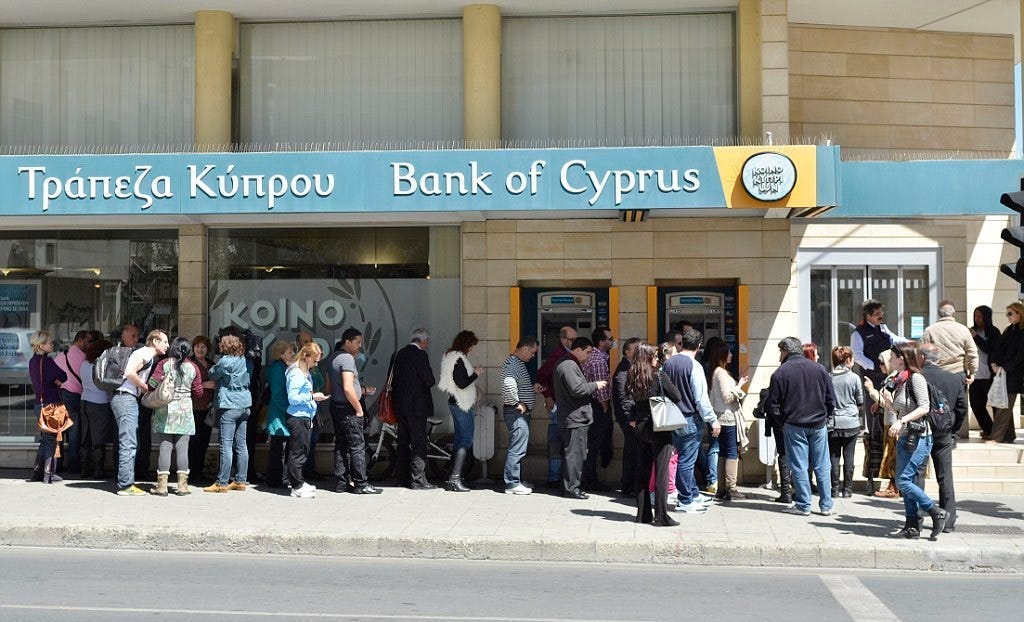
Two years later, Greece imposed capital controls that capped ATM withdrawals and blocked transfers out of the country. Banks closed for weeks.
Mind you, these are EU member states.
Countries with the euro, shared banking frameworks, modern financial systems. Not some local bank in a lesser known country.
So what do you do with local accounts?
I have two local accounts in Thailand. I use them every day. But I would never put six figures in either of them. A local account is for living your life. Wealth belongs somewhere else.
Takeaway: Use your local bank for groceries. Keep your wealth somewhere else.
Fintechs are tools, not banks
On a call last week, a client’s husband asked me a fair question:
“I already have a Wise account. What’s different about what you’re describing?”
(What I was describing is in the next section.)
I use Wise every month.
I’ve used it across six countries over five years. It converts currency at the real exchange rate, charges low fees, and moves money in hours instead of days.
But Wise is not a bank.
It doesn’t have a banking license.
If you need a refresher on what fintechs are, and what they are good for, read this article.
The money in Wise is safeguarded, meaning it's held separately from Wise's own funds. If you opt into their interest feature on USD, you get FDIC pass-through insurance up to $250,000. Without that opt-in, there's no deposit insurance. The money is “ring-fenced”, but not insured.
Wise is good at what they do:
Moving money across borders cheaply and quickly.
But I would never park $50,000+ in a fintech account.
The problem is that people confuse a tool for transferring money with a place to store wealth. But retirement savings need a home with a banking license, deposit insurance, and a jurisdiction that has no reason to restrict your access.
Takeaway: Wise is a tool, not a vault. Know the difference.
The 4th bank account
At the end of the 3 accounts article, I promised more sophistication.
Separate accounts for investments. Physical asset storage in different jurisdictions. Keeping your main reserves in secure places like Switzerland or Singapore.
This is what I was talking about.
The fourth account sits in a country where you don’t live and where you’re not from.
A jurisdiction that has no connection to you other than holding your money. Call it your “own personal Switzerland” (whether the account is actually in Switzerland or not).
Why does location matter?
Because a bank in Panama or the Caribbean or Singapore is not subject to Spanish domestic banking regulations. It can’t be frozen because your residency card expired or because Spain changed a reporting threshold.
And while the bank reports your account to the IRS under FATCA (every foreign bank in the world has to), a US court cannot directly order a foreign bank to freeze your funds if the bank has no US presence. Reaching the account requires international legal cooperation through treaties, not a domestic administrative action.
Both countries know the money is there. You report it yourself on your FBAR and Form 8938. But knowing about an account and controlling the institution that holds it are two different things.
I have accounts in several countries.
Some in Europe, some in Asia, one in the Middle East, one in Central America and one in the US. The European accounts are infrastructure I’ve kept since before I left. The Asian accounts handle daily spending and part of the investment side. The Middle East and US accounts are for business. Central America is where my wealth sits and grows.
It also pays better than you'd think.
Most of these accounts are multi-currency. The one I use holds 10 currencies. You can park money in US dollars, convert to Euros or Swiss francs when rates are favorable, and earn interest on whichever currency you hold.
The account earns interest on USD deposits, and comes with debit and credit cards that work internationally.
And the capital backing is often stronger than in the US. Large US banks hold CET1 capital ratios around 13% on average. Banks in the Eastern Caribbean maintained capital adequacy ratios around 19% as of early 2025, with some individual banks running well above that.
In plain terms, for every dollar of risk these banks take on, they hold more equity backing it than a typical US bank does.
Here's what the full setup looks like:
US home base for income (Social Security, pensions, brokerage withdrawals)
Fintech bridge for converting and moving currency cheaply
Local spending account for daily life in your new country
“Neutral zone” account for storing and growing your wealth outside both jurisdictions
Is this legal? Completely.
Of course, you need to report the account annually to the US Treasury via FBAR if your foreign accounts exceed $10,000 total, and also report it to the IRS via Form 8938 if foreign assets exceed $200,000 (for Americans living abroad, double that amount if you file jointly). And depending on where you move, you may need to declare it to your residence country as well.
The reason why US-based financial advisors are not recommending it is because they lose when you move money offshore.
Their revenue comes from layers of fees that are buried so deep in the fine print most clients never see the real number. The median all-in cost for a managed portfolio in the US is 1.5% to 1.85% annually, and that's before you count the bid-ask spreads on every trade, which never appear on any statement.
Most of these fees are deducted before you ever see your returns, reducing what you earn without a single line item or invoice. When you move assets to an international bank outside their ecosystem, those fees disappear from their income statement.
So they don't bring it up.
The stories I've heard from clients about what they were paying their US advisor, without knowing it, would make your head spin.
Takeaway: Your wealth belongs in a jurisdiction that has no reason to touch it.
What comes next
Stop assuming that one country’s banking system will always work in your favor.
The Americans I work with who sleep best at night are the ones who spread their financial life across jurisdictions, not because they’re hiding anything, but because they understand that concentration is risk.
Open the account in your home country. Open the account in your new country. Use the fintechs for what they’re good at. And then open the fourth account in a country where you have no ties, no tax residency, and no reason for anyone to look twice.
That’s the neutral zone.
Your own personal Switzerland.
If you have questions about your specific situation, drop them in the comments.
I read them all.
— Ben
PS
If you want help opening an international account in a trusted jurisdiction where your wealth is actually secured, watch this video. I walk you through how I set up my own multi-country banking structure and how my clients are doing the same. And if you want your own 4th account in a neutral zone, you can book a call with me here, and we get the process started right away.

wow, so helpful!!
Not specifically a question about expat banking, but a large share of my retirement saving is in an uninsured tax-defferred 457 account with a govt-contactor/financial services company, not an actual bank. My portfolio, such as it is, is mostly invested in a relatively low-risk low-yield manner. I'm trying to figure out a way to better protect my money w/o incurring a huge tax liability and secondarily increase my earnings. Any suggestions would help.