


In 1995, Paraguay’s banks started to fail.
Over the next eight years, the country went through three (!) banking crises.
23 banks and 49 finance companies closed between 1995 and 2003.
The cleanup cost up to 13% of Paraguay’s 1998 economy, according to the IMF.
Many of those banks had lent their depositors’ money to companies owned by the bankers themselves.
Paraguay spent the next two decades rebuilding.
It rewrote its banking supervision to international standards.
On July 26, 2024, Moody’s gave Paraguay an investment grade rating for the first time in its history.
Foreigners noticed.
Residency applications went from 28,000 in 2024 to 47,000 in 2025, and I wrote about the new Investor Pass when it launched in April.
Then, on November 3, 2026, Paraguay’s central bank took over Ueno Bank.
Ueno had about 3 million customers, close to 60% of the country’s adults.
Overnight, their cards stopped working and the branches closed.
Two days later, President Santiago Peña resigned.
When the central bank explained what went wrong, it named the same problem that led to the bank failures in the 1990s.
Here’s what we’ll cover today:
How Paraguay went from 23 failed banks to investment grade, and back to a frozen bank
What Ueno did wrong, and the warnings that came months before
What this means for your money in Panama, Uruguay and Switzerland
It starts with a crisis most people outside Paraguay never heard about.
How we got here
Ueno’s collapse makes more sense once you know what happened to Paraguay’s banks 30 years ago.
#1 The crash
In 1989, Paraguay’s 35-year dictatorship ended.
The new government opened up the financial sector, and it opened it fast.
By 1995, a country of 4.5 million people had 37 banks and 68 finance companies.
The laws were loose (to say the least).
Almost anyone could open a bank, and the central bank barely checked what they did with the money.
So the owners used it.
A bank takes your deposit and lends it out.
These banks lent a large share to companies owned by their own shareholders.
When those companies couldn’t pay the loans back, the money was gone, and it was the depositors’ money.
In June 1995, the central bank noticed that some banks could no longer cover their payments to other banks.
When it stepped in, it found parallel accounts that had never been declared.
That was the first crisis.
More came in 1997-98 and 2001-02.
By mid-1998, the IMF counted only a few Paraguayan-owned banks still operating.
Most deposits had moved to foreign banks.
There was no deposit insurance at the time.
Each bailout was paid for by the state.
Paraguay only created its Deposit Guarantee Fund in December 2003, after the last of those crises.
This is the same fund now paying back Ueno’s customers.
Takeaway: When a bank lends your deposits to its owners’ companies, you’re the one carrying the risk.
#2 The comeback
After 2003, Paraguay rebuilt its banking rules around the Basel standards, the international capital rules most countries use.
The Basel standards are a global set of banking rules that tell a bank how much of its own money it must keep to cover losses on its loans.
The riskier the loans, the more of its own money it has to hold, and the rules also limit how much a bank can lend to one group of linked companies.
But each country writes these rules into its own laws, and its own central bank has to enforce them.
The results showed.
Moody’s gave Paraguay its first investment grade rating in July 2024, and S&P followed on December 17, 2025.
With the ratings came the foreigners.
As I wrote in May, Paraguayan residency gets you a cédula (the local ID card) and the cédula is what you need to open a bank account there.
And the easiest bank account to open was?
You guessed it. Ueno.
Ueno started in April 2021, when the Vázquez family’s business group bought a finance company called “Financiera El Comercio”.
By December 2021, it was rebranded as “Financiera Ueno”.
You could open a savings account entirely from your phone, in minutes.
Paraguayans loved it:
Ueno got a full banking license in December 2023.
In June 2024, it absorbed Visión Banco, a traditional bank with 30 years of history.
By June 2026, Ueno said it had 2.94 million customers, close to 60% of the country’s adults.
In March 2026, it sold a $350 million bond to international investors, the largest ever by a Paraguayan bank, and investors asked for 1.5 times that amount.
In July, it reported the strongest half-year in its history.
From finance company to the bank of half the country took five years.
Sounds like a success story.
But behind the scenes, things were not as great.
Takeaway: A strong country rating tells you next to nothing about the bank that holds your money.
#3 The warning
The central bank saw the problem in June 2026.
The central bank’s supervisors flagged loans from Ueno to companies linked to Grupo Vázquez, the business group that owned the bank.
It was the same pattern as 1995:
Depositors’ money going to the owners’ own companies.
The person at the top of the central bank was Carlos Carvallo.
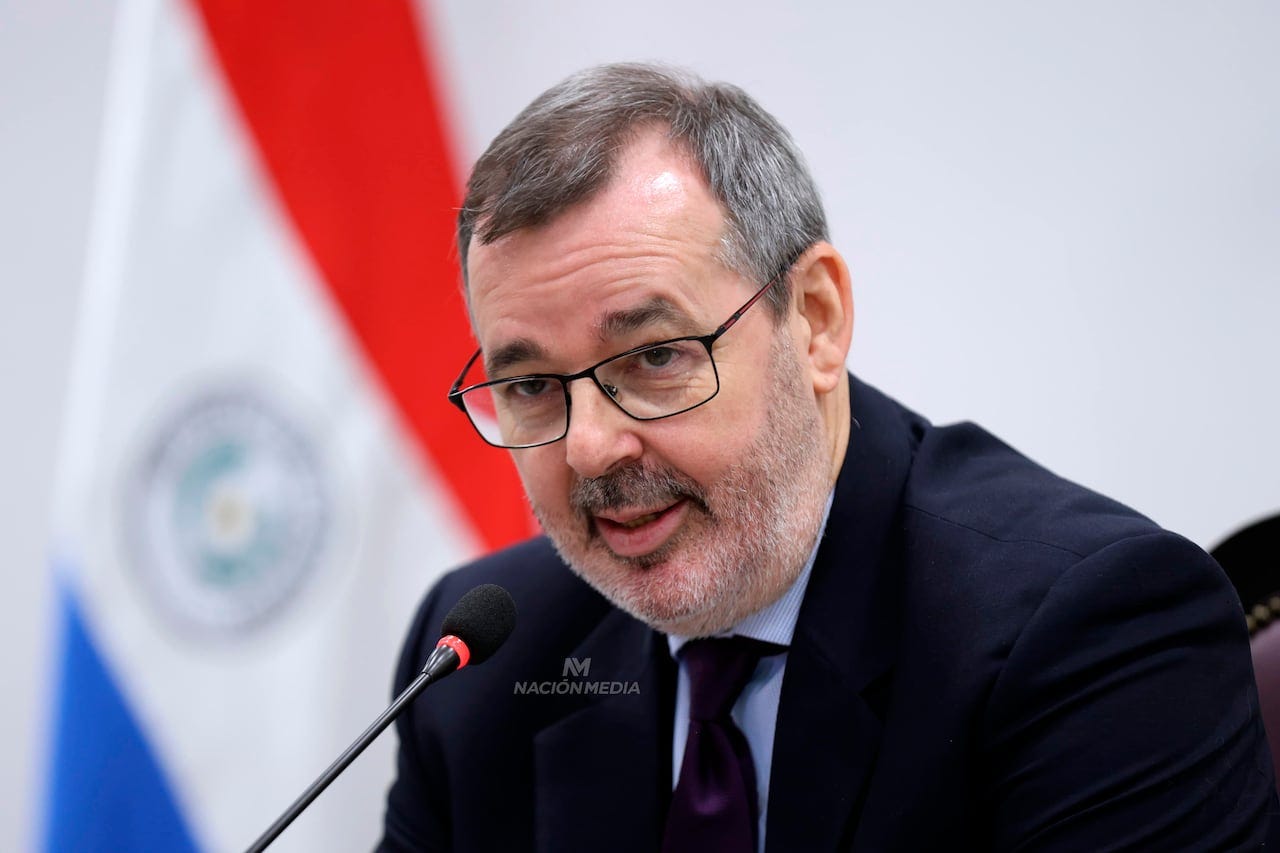
He ran Financiera Ueno until August 2023, and President Peña appointed him to the central bank shortly after.
Meanwhile, government money kept flowing in.
By the time of the freeze, Ueno held close to $850 million in public funds. The state pension fund alone had $355 million there (about 9% of everything it invests).
Then, in October, the signs went public:
Leaked central bank documents showed excess lending to companies linked to Grupo Vázquez.
Fitch moved Ueno’s outlook to negative, citing the bank’s fast growth and its large intangible assets.
Ueno’s bonds fell from 99 cents on the dollar in March to about 87 cents.
Lawmakers asked Peña to replace the central bank’s leadership.
Ueno’s board promised “very good news” on new capital within days.
Peña defended the bank and called the concerns a smear campaign.
On November 2, Ueno said it was operating normally.
That night, the central bank’s board voted to shut it down.
Every one of these signs was public by the end of October (except the first).
Takeaway: The warning signs were in the news weeks before the freeze, if you knew which ones to read.
#4 The freeze
On Monday night, November 2, the central bank’s board voted unanimously to put Ueno into resolution.
Resolution means the central bank takes over the bank. It can move deposits to healthy banks, then sell whatever is left to pay creditors.
By Tuesday morning, nearly 3 million customers couldn’t withdraw or transfer any money.
Branches closed.
Cards stopped working.
People who got their salary through Ueno couldn’t reach it.
Here is how the week went:
November 3: Carvallo resigned from the central bank, and protests started in Asunción.
November 3-4: police detained eight Ueno executives, who were brought before prosecutors the next day.
November 5: Peña resigned in a video posted to X (minutes later, the lower house voted 78 to 0 to impeach him anyway).
The next day, as the Senate held his impeachment trial without him, he posted this on X:
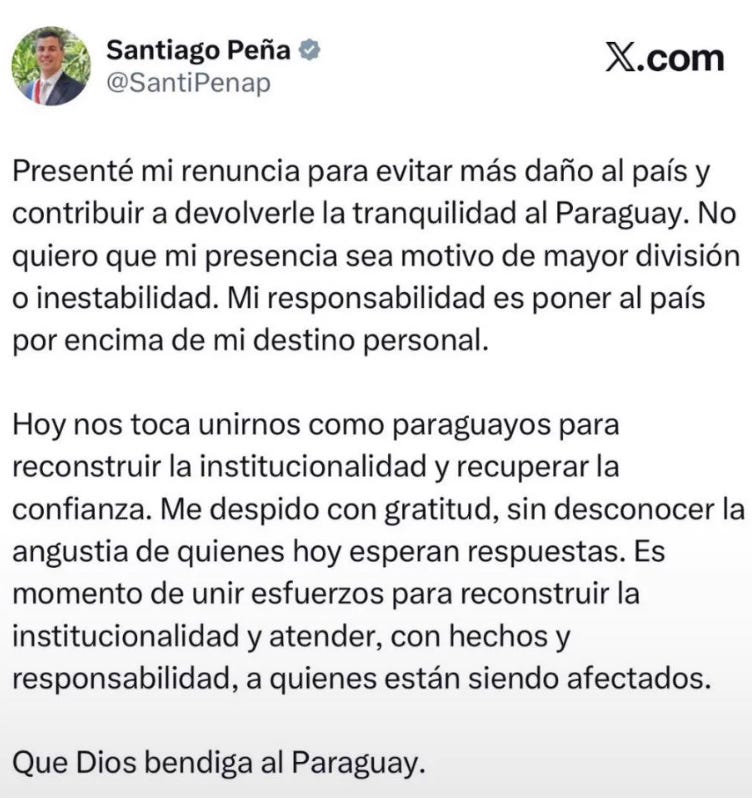
In English:
I submitted my resignation to avoid further damage to the country and to help return tranquility to Paraguay. I do not want my presence to be a cause of greater division or instability. My responsibility is to put the country above my personal destiny.
Today it is our turn to unite as Paraguayans to rebuild the institutions and recover trust. I say goodbye with gratitude, without ignoring the anguish of those who today are waiting for answers. It is time to join efforts to rebuild the institutions and to attend, with actions and responsibility, to those who are being affected.
May God bless Paraguay.
So who gets their money back?
The Deposit Guarantee Fund from 2003 covers up to 75 minimum monthly wages per person, per bank (right now, that’s about $38,000).
The central bank estimates it fully covers about 97% of Ueno’s depositors, because most of them had small balances.
On November 5, Congress passed an emergency law to speed this up.
Each customer gets an advance of up to about $19,800, paid into an account at another bank within five working days.
Anything above $38,000 is a different story.
A deposit is legally a loan you make to the bank.
If the bank fails, the guarantee pays the first $38,000.
Everything above that waits until the central bank has sold Ueno’s assets, and nobody knows yet how much that will bring in.
Takeaway: Every dollar above the guarantee turned Ueno’s customers into creditors waiting in line.
It’s not just Paraguay
You might think:
“That’s Paraguay. It wouldn’t happen to my bank.”
But Ueno failed in a way banks have failed for decades.
A business group owns a bank.
The bank lends its customers’ deposits to the group’s own companies.
The people who should be checking are close to the owners (conflict of interest).
Then the losses show up all at once, and the customers can’t get to their money.
To be fair to Paraguay, its central bank did better than in 1995.
The other banks kept running.
Ueno held about 7% to 8% of the country’s deposits, and Paraguay’s banking association called it an isolated case.
Payouts started within three days, and eight executives were in custody within two.
In the 1990s, there was no guarantee fund at all.
But the central bank flagged the problem in June and froze the bank in November.
For those five months, customers kept depositing their salaries.
The state pension fund kept its $355 million there. And the man at the top of the central bank was the man who used to run Ueno.
Rules on paper protect you only as far as the people enforcing them.
So the useful question is about you:
How much do you trust your bank?
How to know if you can trust a bank
You can check any bank with four simple questions.