


Before we start, an announcement.
Over the past months, many of you have asked me to help you build your Plan B (residency, banking, investments, all set up in the right order).
On Monday, I’m opening 5 spots for my new program, “Your Plan B”.
If you want it all in place before 2027, this is it.
Everything is built around you, and you get access to my private network, with options you won't get on your own, like Swiss private banking at a fraction of the usual minimum.
5 spots, and 1 already taken.
Reply “Plan” to this email, and you’ll hear from me before anyone else.
Now, let’s look at the best countries to move to.
In July 2025, I published my list of the 3 best countries to move to from the US.
I wrote it for remote workers who earn from clients and need a digital nomad visa.
But the people who actually hire me are planning a retirement.
Every client I worked with this year was between 45 and 88.
And a lot has moved in the 15 months since.
So this year’s list is for Americans 50+ who want to retire abroad, or at least have a place lined up before they need one.
I also picked one country in Europe, one in the Americas and one in Asia on purpose.
Here’s what we’ll cover today:
Why I picked these three (and why you should still start with you)
One country in Europe, one in the Americas and one in Asia
A real client or reader story for each one
First, how I picked them.
Why these three
I always say:
Start with you, not with a country.
That still holds.
These three are where I’d start looking, because Americans 50+ already move to all of them.
Which one fits you depends on your budget and on how often you want to fly home.
At the end, I’ll show you which country fits which kind of person.
Here are my three.
#1 Portugal (Europe)
Portugal has the lowest income requirement of all the European retirement visas I’ve compared.
According to AIMA, Portugal’s immigration agency, 19,258 Americans lived in Portugal in 2024.
That’s 36% more than the year before.
Who it fits
You want to live in Europe on a modest income, and you plan to spend most of the year there.
The visa
Most retirees come in on the D7 visa.
You need at least €920 a month in passive income, such as Social Security, a pension, dividends or rent.
A couple needs €1,380 a month.
You also need about €11,040 in savings in a Portuguese bank account.
I covered every step of the application here.
Your US income
Portugal taxes your Social Security and your pensions at its normal rates, which go up to 48%.
The old NHR tax break closed to new applicants in 2024.
The tax treaty between the US and Portugal makes sure the same income isn’t taxed twice.
If you have a Roth IRA, Portugal taxes the growth when you take money out.
Healthcare
Once you’re a resident, you can register with Portugal’s public health service.
Private insurance on top gets you faster appointments, and the price depends on your age.
What a month costs
Portugal is not as cheap as some options in the Americas, but compared to the US, very affordable.
A couple lives well in Porto on around €2,500 to €3,000 a month.
(Lisbon costs more.)
Where to live
Porto, if you want a real city that’s cheaper than Lisbon.
Lagos on the Algarve, if you want warm winters and a large English-speaking community.
I compared both here.
What to watch out for
Since May 19, 2026, Americans need 10 years of residence before they can apply for Portuguese citizenship.
The timeline starts on the day your residence card is issued.
And getting that card from AIMA can take months after you arrive.
If a European home is what you want, this changes very little. If a second passport is your main goal, plan for the long wait.
I have a great network of professionals in Portugal, in case you decide to work with me.
A client who’s doing it
Rhetta and Scott, both in their 60s, moved to France years ago, and it went badly.
This time they decided on Portugal.
They started their D7 paperwork in August 2026 and plan to move in 2027.
Here’s Scott on how we narrowed it down:
Takeaway: €920 a month gets you a home in Europe, and the passport is a 10-year project.
#2 Panama (the Americas)
Panama is the closest of the three to the US.
Panama City is about three hours from Miami, and the country uses the US dollar.
Who it fits
You have a pension of at least $1,000 a month, and you want to stay a short flight from your family.
The visa
Most retirees come in on the Pensionado visa.
You need a lifetime pension of at least $1,000 a month, and US Social Security counts.
If you buy a property worth $100,000 or more, the requirement drops to $750 a month.
Each dependent who comes with you adds $250 a month.
Approval gives you permanent residency from day one.
I compared the Pensionado with Panama’s other route here.
Your US income
Panama only taxes income you earn inside Panama.
Your Social Security, your pension and your IRA withdrawals are not taxed there.
You still file your US return every year, the same as you do now.
Healthcare
Panama City has private hospitals with English-speaking doctors.
Pacífica Salud, in Punta Pacífica, is affiliated with Johns Hopkins Medicine International.
Pensionado holders also get 20% off doctor visits and 15% off hospital bills.
What a month costs
A couple lives on around $2,500 to $3,400 a month in Panama City.
In Boquete, in the highlands, it’s around $2,100 to $2,800.
Where to live
Panama City, if you want the hospitals and the airport close by.
Boquete, if you want cooler mountain weather and a large American retiree community.
What to watch out for
The Pensionado doesn’t let you take a salaried job in Panama.
And you have to visit at least once every two years, for more than 24 hours, to keep your residency.
A client who’s doing it
Lorraine had her Italian passport on the way and was sure she’d retire in Italy.
Then she looked at how Italy taxes its own citizens, and the plan changed.
We built her plan around Panama, and she got her residency card there in July 2026.
She qualified for the Pensionado and still took a different visa.
Here’s Lorraine on what it was like:
Takeaway: $1,000 a month in pension income gets you permanent residency in a dollar country three hours from Miami.
#3 Thailand (Asia)
I live in Bangkok, so this is the one I know best.
Thailand is the cheapest of the three, and private healthcare is the main reason retirees stay.
Who it fits
You want the lowest monthly cost and warm weather all year, and you’re fine with a long flight home.
The visa
Most retirees use Thailand’s retirement visa, which starts at age 50.
You need 800,000 baht (about $24,000) in a Thai bank account, and you renew the visa every year at your local immigration office.
The alternative is the Thailand Privilege visa, which most people still call the Elite visa.
I hold one myself.
It’s a paid membership: 900,000 baht (about $27,000) gets you 5 years.
There’s no age limit and no income test.
Each entry gets you a stay of up to one year, and the program files your 90-day address reports for you.
Your US income
Under the US-Thailand tax treaty, only the US can tax your Social Security.
For other income, Thailand taxes foreign income you bring into the country in a year when you live there 180 days or more.
Savings you built before January 1, 2024 can be brought in tax-free.
Healthcare
Bangkok’s large private hospitals, such as Bumrungrad and Bangkok Hospital, have English-speaking doctors and international accreditation.
A doctor visit costs a fraction of what you pay in the US.
I spent less than $3,000 on healthcare in 2026 so far, including an MRI, a full-day health checkup, several specialist visits and more.
My international health insurance paid back 90% of it, and the policy costs me less than what it paid back.
What a month costs
A couple lives comfortably on around $1,600 to $2,100 a month, before health insurance.
Central Bangkok costs more, and Chiang Mai costs less.
Where to live
Bangkok, if you want the best hospitals, a metro and direct flights everywhere.
Chiang Mai, if you want a slower city that’s cooler in winter and has a large retiree community.
What to watch out for
On the retirement visa, you report your address to immigration every 90 days.
And foreigners can’t own land in Thailand, only condos.
A reader couple who did it
Mike and his wife, both in their 60s, have lived in Thailand for more than a decade.
They switched from a volunteer visa to the 10-year retirement visa, and their visa agent handles the renewal once a year.
I wrote up their full setup, including banking and taxes, here.
They locked in their global health insurance before they turned 60 and pay around $400 a month for both of them.
Takeaway: About $24,000 in a Thai bank, or a one-time Privilege membership, gets you a long-term visa, and your Social Security stays free of Thai tax.
Why pick just one?
If you had to choose one today, here’s how I’d decide:
Portugal if you want a home in Europe and plan to live there most of the year.
Panama if you want to stay close to the US and keep living in dollars.
Thailand if you want the lowest monthly cost and don’t mind a long flight home.
But you can also hold more than one.
My client Cheri is 60 and lives in upstate New York.
This year we built her a setup across three regions:
Mexico is her base, with permanent residency.
Italy is her passport, through citizenship by descent.
Thailand is her long game, with a 10-year Privilege visa.
In her words:
“Got one in the Americas, and I’ll have one in Europe, and I’ll have one in Asia, which really opens the world.”
I wrote up how she got there here.
You don’t have to copy her setup country for country.
But the idea behind it works for almost anyone:
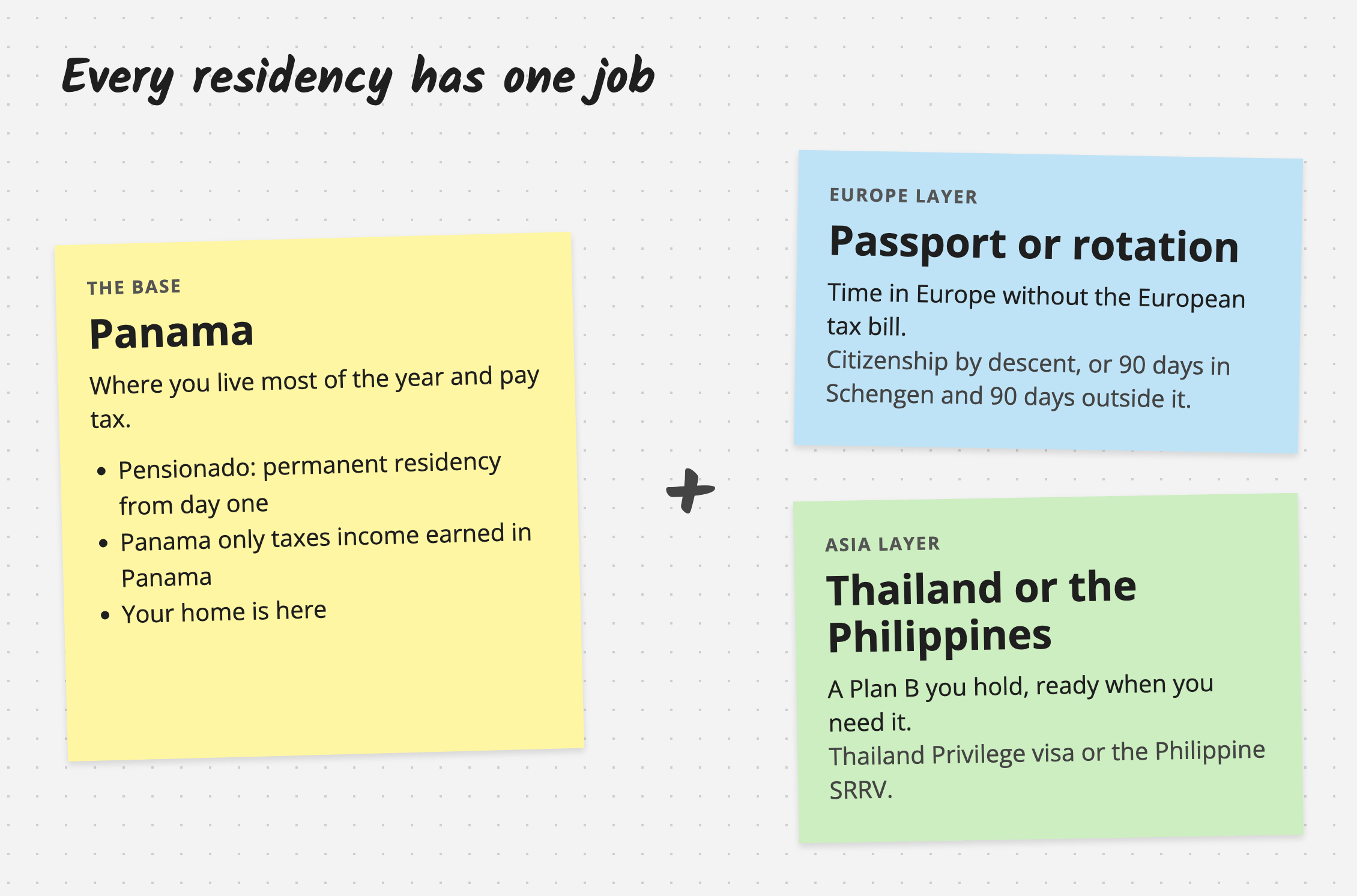
One base where you live and pay tax, plus residencies in other regions that give you options.
Below, I show you how to build one tax-efficient base, add Europe without the European tax bill, and keep Asia as a Plan B.
Every residency has one job
You need one base, and you can add two layers on top of it.
I just recorded a free 28-minute training called “The Exit System” that shows the three steps to set up your Plan B options (residency, banking, investments) outside the US, in the right order.
👉 Watch it here
Now the question is, where do you live and pax tax?