


Dublin, June 11, 2026.
Ireland announces new visa rules for three countries: St. Kitts and Nevis, St. Lucia, and Nicaragua.
Starting June 15, their citizens need a visa to enter.

Two of those three countries sell citizenship. A St. Kitts passport costs around $250,000, and visa-free travel is the main thing it has been sold on.
And Ireland is not an outlier.
Norway has been turning away Caribbean passport holders at the border since 2025, without changing a single written rule.
Behind both is Brussels.
In November 2025, the EU rewrote its visa suspension rules.
Selling citizenship can now, by itself, justify cutting a country’s visa-free access.
The Caribbean feels that pressure already. I mentioned some of the measures (St. Kitts asking for fingerprints, Dominica announcing in-person visits) that are taken here.
Now, “villain” is a big word.
Europe hasn’t banned anything (yet).
What changed is the posture:
The EU now treats bought passports as a security risk, and it built the legal tool to act on that view.
Here’s what we’ll cover today:
The new EU rule that names bought passports as grounds to suspend visa-free travel
Why the passive, never-visit passport is ending (St. Kitts and Dominica now want you there in person)
Two ways to respond, depending on what you actually need
First, the legal tool that the EU has built.
The EU tool Ireland used first
The tool has a name:
The visa suspension mechanism.
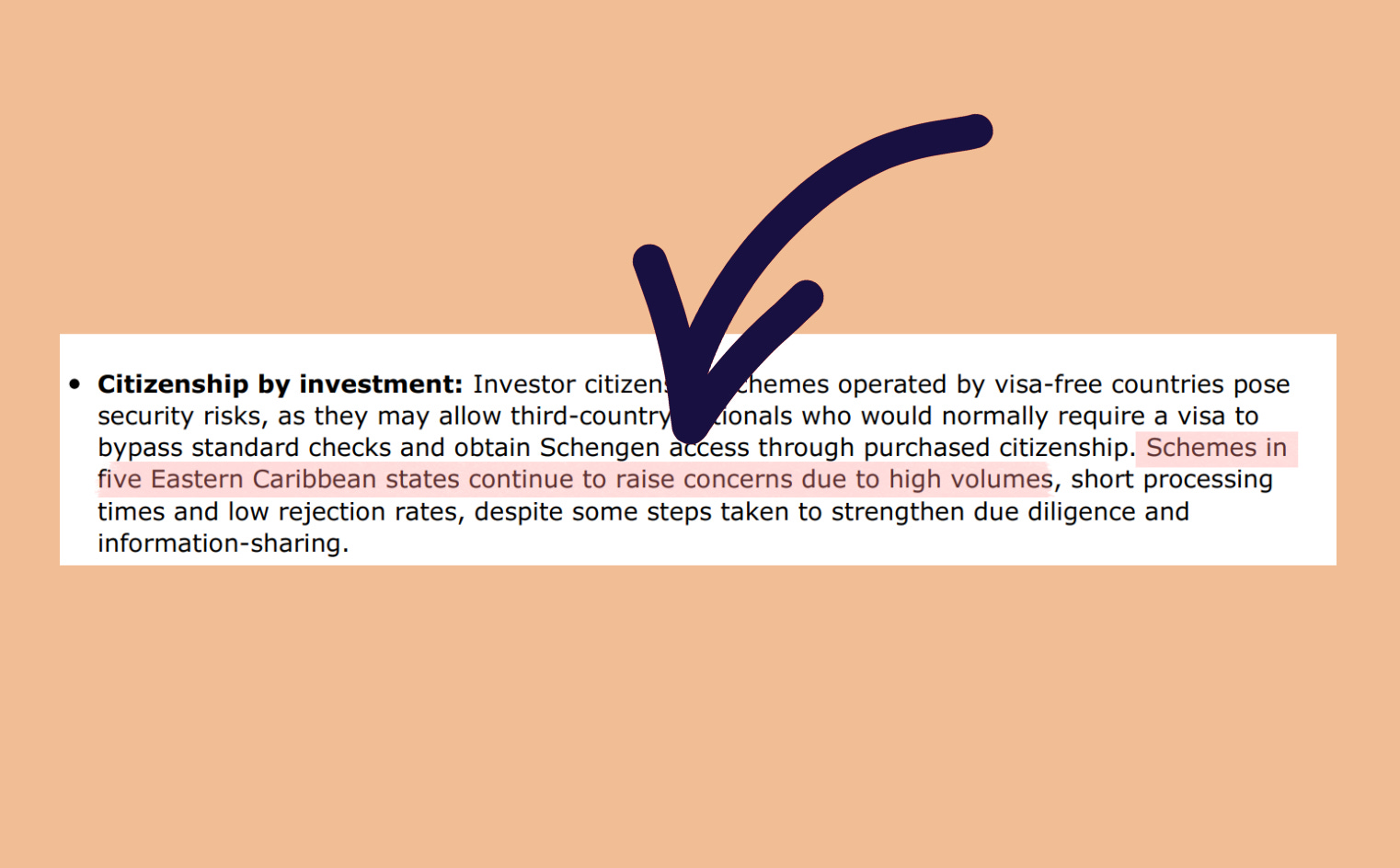
The mechanism is how the EU cuts visa-free access for a country on its list.
Vanuatu already went through it.
The EU froze its access in 2022 and revoked it for good in December 2024, after years of warnings about who was getting its $130,000 passports.
On November 17, 2025, the Council of the EU gave final approval to a rewrite of that mechanism.
Three changes are relevant.
First, the rules now name investor citizenship directly.
A country can lose visa-free access for granting citizenship to people with “no genuine link” to it.
Check that phrase against the Caribbean model:
Pay a fee.
Pass the checks, never set foot on the island.
Does that sound like a “genuine link” to the country?
Second, the trigger got easier to pull.
The EU counts how a country’s citizens behave inside Europe.
How many get refused at the border, how many overstay, how many file asylum claims, how many commit serious crimes.
Under the old rules, one of those numbers had to jump by 50% year over year before Brussels could start suspending visa-free access.
Now a 30% jump is enough.
Third, suspensions last longer.
Twelve months instead of nine, extendable by another 24.
None of this names a specific country yet. The mechanism is a “loaded gun” on the table.
Ireland shows the “climate” around it.
Ireland is not in Schengen and didn’t need Brussels to act.
It announced its visa rules under national law, and they cover ordinary, diplomatic, and service passports, plus airport transit.
Migration Minister Colm Brophy called it:
“A carefully considered decision that brings Ireland more closely in line with the approach taken in the United Kingdom and across Europe.”
The UK had already cut Dominica and Vanuatu in 2023, then stripped Nauru of visa-free access in December 2025, each time pointing at citizenship sales.
Look at the timeline:
The EU finalizes its mechanism in November.
The UK cuts Nauru in December.
Ireland cuts 3 countries in June.
Three moves in eight months, all in the same direction.
Takeaway: The EU now has a written legal path to cut visa-free access from any country selling citizenship, and governments across Europe are already moving in step.
The old bargain is collapsing
One of my partners Andrew made the same point recently, and I strongly agree:
For decades, the Caribbean citizenship countries operated under an “unwritten deal” with the West.
St. Kitts, St. Lucia, and Dominica are former British territories.
Small islands, small economies, and one export that always sold: citizenship.
The deal was simple.
Run your programs cleanly, cooperate with Western authorities, stay aligned, and your citizens keep their visa-free access.
They held up their end.
After the UK cut Dominica in 2023, all five Caribbean programs signed a common-standards agreement in March 2024.
They tightened screening, shared data, and revoked citizenships from applicants who had hidden past visa denials.
And they’re getting cut off anyway.
Notice what the recent cuts have in common.
The UK didn’t point to a Nauru scandal when it moved in December.
It pointed at the existence of the program.
The EU’s new rules work the same way: selling citizenship to people with no genuine link is, by itself, enough.
And the pressure is no longer abstract.
In late June, the European Commission wrote to all five Eastern Caribbean CBI states demanding a phase-out by June 2028, with Schengen access on the line.
This phenomenon can also be observed in international banking.
The OECD keeps a public list of citizenship-by-investment programs it flags as high-risk, and the Caribbean programs are on it.
Compliance departments read that list, naturally.
Walk into a Western bank with a Caribbean CBI passport as your only citizenship, and the conversation starts in the risk department.
The passport still works at most airports.
At the bank counter?
Less and less.
What this tells me is one thing:
The West doesn’t like people who create options for themselves. And it starts putting the screws on them.
Takeaway: The Caribbean programs did what the West asked and lost access anyway, because a bought passport’s value is decided by the countries honoring it, never by the one selling it.
The passive passport is dead
Europe is one half of the story.
The programs themselves are ending the other half:
The promise that you never had to show up.
St. Kitts has the oldest program in the world, selling citizenship since 1984.
It now requires biometric enrollment, done in person at an approved center.
This covers everyone who bought the passport, family members included.
I covered the rollout of the new centers that have been established in the June mobility roundup.
In January, Prime Minister Terrance Drew announced the program will shift away from pure pay-and-done citizenship toward routes built on residency and real participation in the country.
Not law yet, but the direction is public.
St. Kitts is building exactly the “genuine link” the EU says is missing.
Dominica, on the other hand, made it concrete.
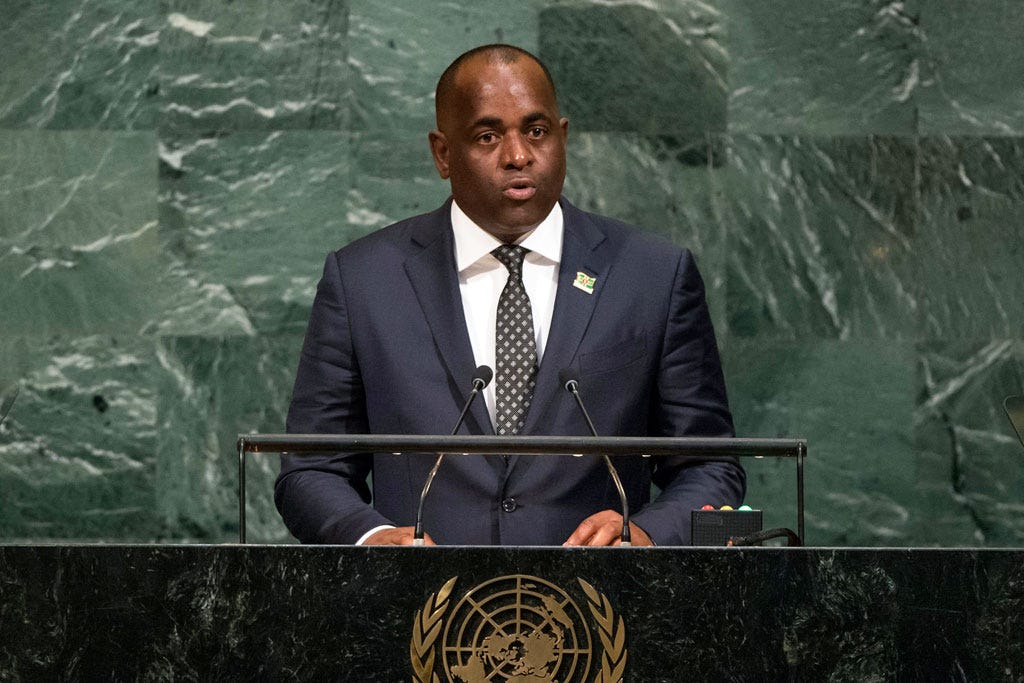
On June 10, Prime Minister Roosevelt Skerrit ended the fully remote model that defined his program since 1993:
“You will have to come to Dominica to receive and renew your passport as a citizen.”
The legislation is still being drafted.
But the “no-visit passport”, Dominica’s signature product for 33 years, is done.
The five Caribbean programs have also proposed a common rule. New citizens spend at least 30 days in-country during their first five years. Not law everywhere yet, but Antigua has already written it into a bill.
And if you want to see where the cheap end of the market goes, look at Nauru. Their $90,000 discount window closed June 30 (the program continues at $115,000).
At first glance not a bad price for a second passport.
But look at what it gives you.
Roughly 90 destinations, with the US, Canada, the UK, and Schengen all missing.
My read: two different things are happening here, and I only welcome one of them:
Stricter rules are healthy. Biometrics, tighter screening, in-person visits, real presence. Programs that take this seriously are the ones that might survive.
Cutting access is the wrong move. The people losing visa-free travel bought legally and passed every check. Cutting their access after they spent all that money doesn't sit right with me. It’s the same kind of betrayal that Portugal did with extending the citizenship timeline for people who paid hundreds of thousands of dollars for the Golden Visa, just to then get screwed afterwards.
Takeaway: Every serious CBI program now demands effort and presence, so the passive backup passport you could buy from home is gone.
Two ways to respond
Say you were shopping for a bought passport, or you hold one already.
There are two ways to play this.
Option 1: Decide this was never your fight.
You hold a US passport.
It still opens nearly every door you care about, and nobody in Brussels is threatening its visa-free access.
If your plan is residency in Portugal, Panama, or Thailand, the CBI crackdown costs you exactly nothing.
The Caribbean passport was never the right tool for that plan anyway.
Don’t buy insurance against a problem you don’t have.
Option 2: Build residency first, and let citizenship come later.
For most of my readers, this is the whole game.
A residence permit in a country you’d actually live in delivers what the bought passport promised:
A place to go and a legal right to stay.
Plenty of solid residency programs cost under $10,000 in fees. Not $250,000.
And time works in your favor too.
Live in your residency country long enough and naturalization opens up.
The passport arrives as a byproduct of a life, with a genuine link no EU lawyer can question.
Takeaway: Residency in a country you’d actually live in delivers what the bought passport promised, costs a fraction, and you can still naturalize from there.
Conclusion
That’s it.
Three things worth keeping:
The EU can now suspend visa-free access specifically because a country sells citizenship. Approved November 17, 2025. Ireland’s four-day cut shows how fast this moves now.
The “passive” passport is finished. St. Kitts wants your fingerprints by July 2027, and Dominica wants you on a plane. Buy-and-forget no longer exists.
A bought passport is only as good as the countries still honoring it. That list got shorter twice in the last eight months, and the EU now has the tool to shorten it further.
And a question for you:
If you could only have one, a passport that gets you into 150 countries, or the permanent right to live in the one country (but no passport) which one would you choose (and why)?
Tell me in the comments. I read them all.
Appreciate you being here,
— Ben
PS
Are you unhappy in the US, or worried about keeping all your money in one country’s system?
I help US citizens with this every week.
Some need the right residency, while others want part of their money out of the US system.
If that sounds like you, book a call here.
I’ll look at your situation and tell you exactly what I would do.
Residency is enough for me. All I care about is the fact I don’t have to leave after a proscribed period.
I would rather have a passport that gets me into 150 countries. I like the ability to move around, not get stuck in a country that I dont agree with the polices.