


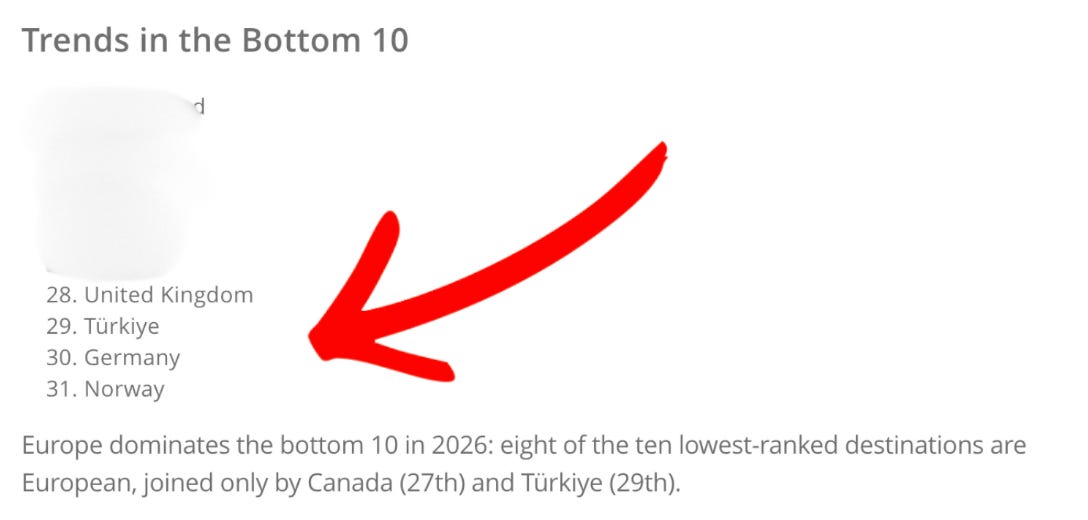
Turkey, the United Kingdom, Germany and Norway finished at the bottom of one of the biggest expat surveys this year.
They rank 28th, 29th, 30th and 31st out of 31 countries in the Expat Insider 2026 survey.
Americans move to all four for good reasons:
Turkey because a pension goes further.
The UK because everyone speaks English.
Germany because that is where their grandparents came from.
Norway because it feels safe at night and the social system works.
The regret starts later, when the visa office, the health insurer and the tax office deal with a retiree from the US.
Here’s what we’ll cover today:
The four countries, and the one reason people move to each
What the system does with a US retiree after arrival: visa, insurance, tax, prices
What to do instead if that reason is your reason
Turkey first.
This post is free to read.
Half of what I write here goes out to everyone, and that only works because a few hundred paid readers cover the rest. They are the reason I can spend a week on one article instead of an afternoon.
If this one was useful to you, please consider joining them.
#1 Turkey
Turkey has no retirement visa.
For years that did not matter.
A lot of foreign retirees used the one-year residence permit for “touristic purposes”: no job, no property, renewed once a year at the local immigration office.
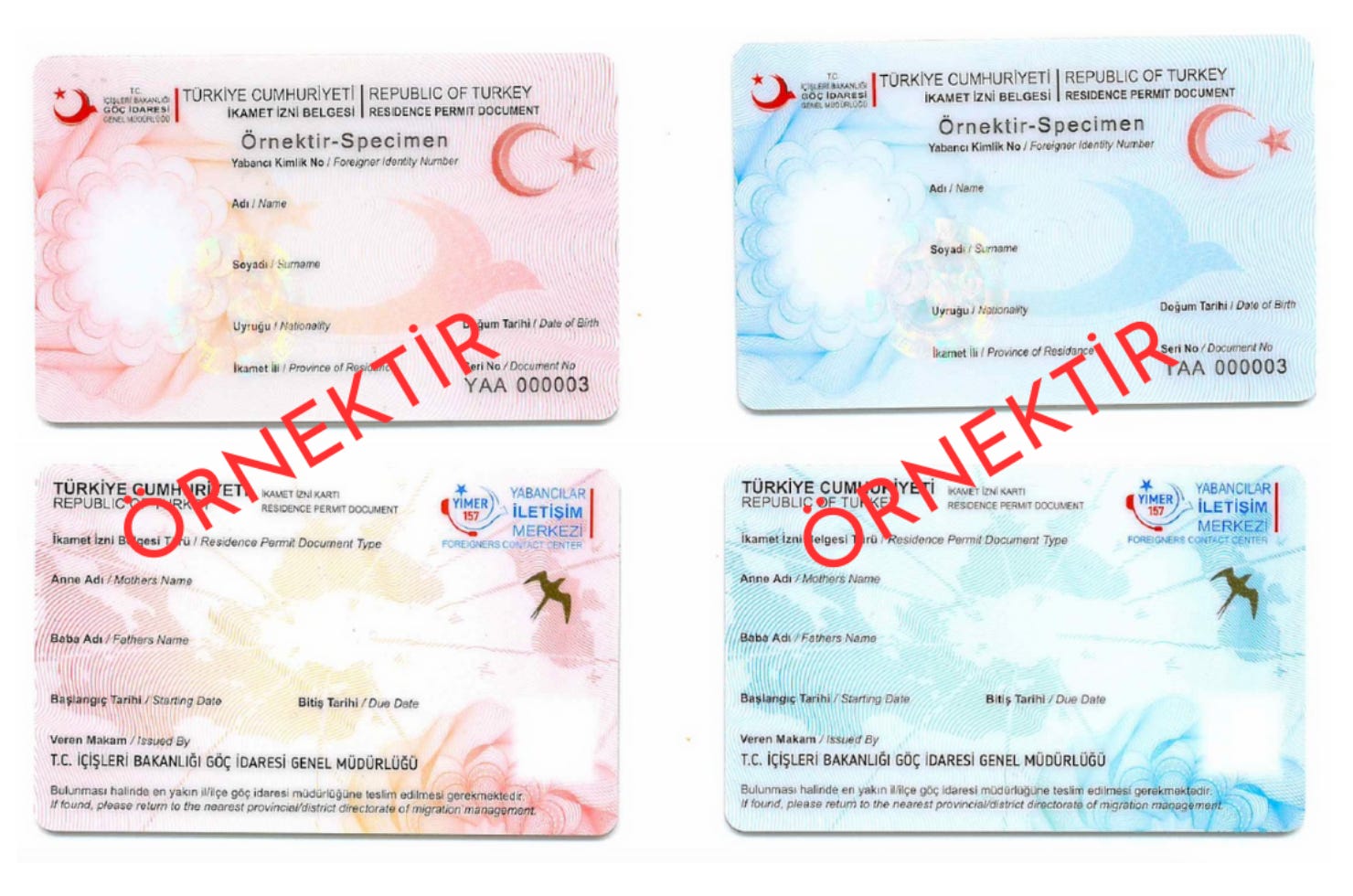
That route has mostly closed since 2023.
A first-time applicant who still applies on that basis most likely gets turned down.
The ones who get approved often get six months instead of a year, and renewals get harder each time.
Two routes remain for a retiree:
Property. Since October 16, 2023, the deed value has to be at least $200,000 to qualify for a residence permit as an owner.
Income. About 42,000 lira a month in 2026, which is 1.5 times the net minimum wage, paid into a Turkish bank account.
(Citizenship for a $400,000 property purchase also exists. I covered it in The 5 Fastest Passports To Get In 2026.)
Both routes work.
But neither is the Turkey people remember from 2019, where you flew in on a tourist visa and sorted out the permit after.
Then there are the prices.
Inflation peaked at 75% in May 2024 and was still at 31.5% in August 2026.
A weak lira does not protect you from that. In the year to July 2026, Turkish prices rose 31% while the dollar gained 17% against the lira, so what you buy in Istanbul got about 13% more expensive in dollars.
I went through those numbers in Turkey’s New Tax Deal (And Why I Would Avoid It).
Five straight years above 30% inflation makes a fixed pension hard to budget, even one paid in dollars.
Takeaway: The permit that made Turkey easy for retirees has mostly closed, and the prices that made it cheap now rise in dollars too.
#2 United Kingdom
The UK closed its retirement visa in 2008.
It was called “Retired Person of Independent Means”.
Also, the investor visa closed in February 2022.
So an American with money, a pension and no British relatives has no visa category to apply under.
British grandparents do not help either. The Ancestry visa is for Commonwealth citizens, and the US is not in the Commonwealth.
The realistic route for a retiree is the family visa, and it needs a partner who is British, Irish or settled in the UK.
The couple has to show a combined income of £29,000 a year, and the applicant’s own pension counts toward it. Without the income, £88,500 in savings held for six months does the same job.
On top of the visa fee comes the Immigration Health Surcharge:
£1,035 per adult per year, paid upfront for the whole length of the visa.
For a couple on a 2.5-year visa that is about £5,175 before anyone has seen a doctor.
I walked through every UK route in How U.S. Citizens Can Move to the UK.
Then there’s tax.
UK residents pay UK tax on worldwide income.
The old remittance basis, which let foreigners keep offshore income out of reach, ended on April 6, 2025.
US Social Security is taxable only in the UK for a UK resident, at UK rates on the full amount.
The US drops its claim under the treaty.
New arrivals who spent the previous ten years outside the UK can claim a four-year exemption on foreign income, which can cover Social Security at first.
Whether it helps in your case is a question for a cross-border tax adviser, and one to ask before you move.
Takeaway: Speaking the language gets you nothing, and getting into the UK without a job offer or a British partner is almost impossible.
#3 Germany
This one is my own country.

According to 2020 census data, German was the top reported ancestry in 23 US states.
Every year some of those people come back to the towns their grandparents left, and they arrive without a visa category to apply under.
Germany has no retirement visa either.
The route is a residence permit “for other purposes” under section 7 of the residence act, granted case by case, usually for one year at a time.
You show you can pay your own way, and you have to obtain private health insurance.
And health insurance is the big one.
An American retiree has no way into Germany’s public health insurance, at any age.
Public insurance is tied to a job.
No German job means no compulsory membership.
The catch-all rule that covers everyone else is closed to non-EU citizens on this kind of permit, and voluntary membership requires years of prior insurance time inside Germany that a newcomer does not have.
Past 55, even taking a German job no longer gets you in. Since January 1, 2026 that rule got tighter still.
I grew up inside this system and paid into it from my first paycheck in 2014.
The public system has long waiting times, and is overall badly staffed.
I don’t regret leaving this malfunctioning healthcare system at all.
The other big one is tax.
Since January 1, 2025, Germany taxes withdrawals from a traditional IRA or 401(k) in full.
Before that only the growth was taxed (Roth withdrawals are still taxed on growth only).
US Social Security is taxed only in Germany for a German resident, at German rates. I explained how the general mechanics work in How Taxes Work When You Retire Abroad.
The two routes that do work for Americans, a Blue Card with a German job or the freelance permit, are in How U.S. Citizens Can Move to Germany.
Neither is built for someone who has stopped working.
In the Expat Insider 2026 survey, Germany finished last of 31 countries for the basics (housing, admin, language, digital life), and 61% of expats said dealing with the authorities is hard.
Imagine my surprise.
Takeaway: Germany will let a retiree with money apply one year at a time, but it will not let that retiree into its public health system, and its bureaucracy is hard to deal with.
#4 Norway
Norway has no residence permit for a retiree from outside the EU.
Not a closed one, not a hard one.
None.
The UDI permit list has categories for work, study, family and protection.
The “own funds” route, where you show NOK 255,191 a year and support yourself, is for EU and EEA citizens only.
So an American with no Norwegian job and no Norwegian family cannot apply as a retiree, at any income level.
The people who do get in, usually through a Norwegian spouse, meet the second problem.
Norway taxes what you own, every year.
The 2026 wealth tax is 1.0% on net wealth above NOK 1,900,000 for a single person and NOK 3,800,000 for a couple, rising to 1.1% above NOK 21.5 million.
(NOK 1.9 million is about $200,000.)
It covers worldwide assets, and your US retirement accounts count in full.
Norway’s Tax Appeals Board refused to treat a US IRA as a pension scheme, so the December 31 balance of your IRA or 401(k) is taxed as wealth.
A couple with $2 million in retirement accounts and no other assets pays roughly $16,000 a year, on top of income tax, for the right to keep owning what they already own.
Do Norwegians get treated differently?
Partly.
A primary home is counted at 25% of its value up to NOK 10 million. A Norwegian couple with a NOK 8 million house and modest savings often sits under the threshold.
An American couple’s wealth is mostly financial, and financial assets count at 100%.
Norway finished last of 31 countries in the Expat Insider 2026 survey. 72% of expats said making local friends is hard, against 40% worldwide, and 25% said they were happy with their social life.
Norway’s border officers also made news in January for turning away holders of bought Caribbean passports.
Takeaway: Norway has no visa for a foreign retiree, and if you get in through family, a 1% yearly tax on your IRA and 401(k) balance is waiting. This is a clear “no thank you” in my book.
What the four have in common
Each move happened for one good reason.
Price, language, roots, safety.
And in each case nobody checked whether the country’s system had a place for a retiree.
Remember this sentence:
Start with yourself, not with a country.
Then check, for every country on your list, the four things that went wrong here:
The visa.
The health insurance.
The tax on what you own.
What the prices do in your currency.
If one of these four reasons is your reason, here is where I would look instead.
Price.
Choose a country at the same price level that has a real retirement visa.
Panama’s Pensionado, Paraguay and Uruguay are in The 5 Easiest Residencies To Obtain In 2026.
Language.
Malta’s Retirement Programme is open to Americans.
The current terms apply only to complete applications received by December 31, 2026.
From January 1, 2027 a new programme replaces it and the minimum tax doubles to €15,000 a year.
I covered the routes in How US Citizens Can Move To Malta.
Roots.
Check first whether you can get a passport by descent.
Germany does not hand out citizenship by descent the way Italy or Ireland do.
Ireland goes back to a grandparent, and more than 30 million Americans claim Irish ancestry.
I am working on an article on the best passports you can claim through your ancestors, and it is coming soon.
Safety.
Look up the wealth tax before anything else.
Spain and Norway have one, and some other countries do as well.
A country can be safe for you and expensive for your IRA at the same time.
Conclusion
That’s it.
One thing worth doing this week:
Take the country at the top of your list and answer four questions in writing:
Which visa would I apply for?
Does the country tax what I own?
Which health insurance strategy works here?
How did prices develop over the last few years?
And remember:
There is no perfect country.
There are only trade-offs that you can live with.
Appreciate you being here,
— Ben
PS: If you already know where you’re going, but you want a safe bank account outside the US, or even move your investments to Switzerland, book a call here and I’ll show you what’s possible.