


“My accounts in the US don’t charge me any fees unless I’m late or something.”
A retiree from Florida said that to me on a call in July 2026, while we were talking about opening a bank account abroad.
My answer:
“US accounts don’t charge you any fees that you see.”
The ones you can’t see are bigger.
When a big US bank converts your dollars to euros, it gives you a worse exchange rate than the real one and keeps the difference.
But your statement doesn’t show it as a fee.
And the fee he did mention, the one for being late, is where the US charges far more than Europe.
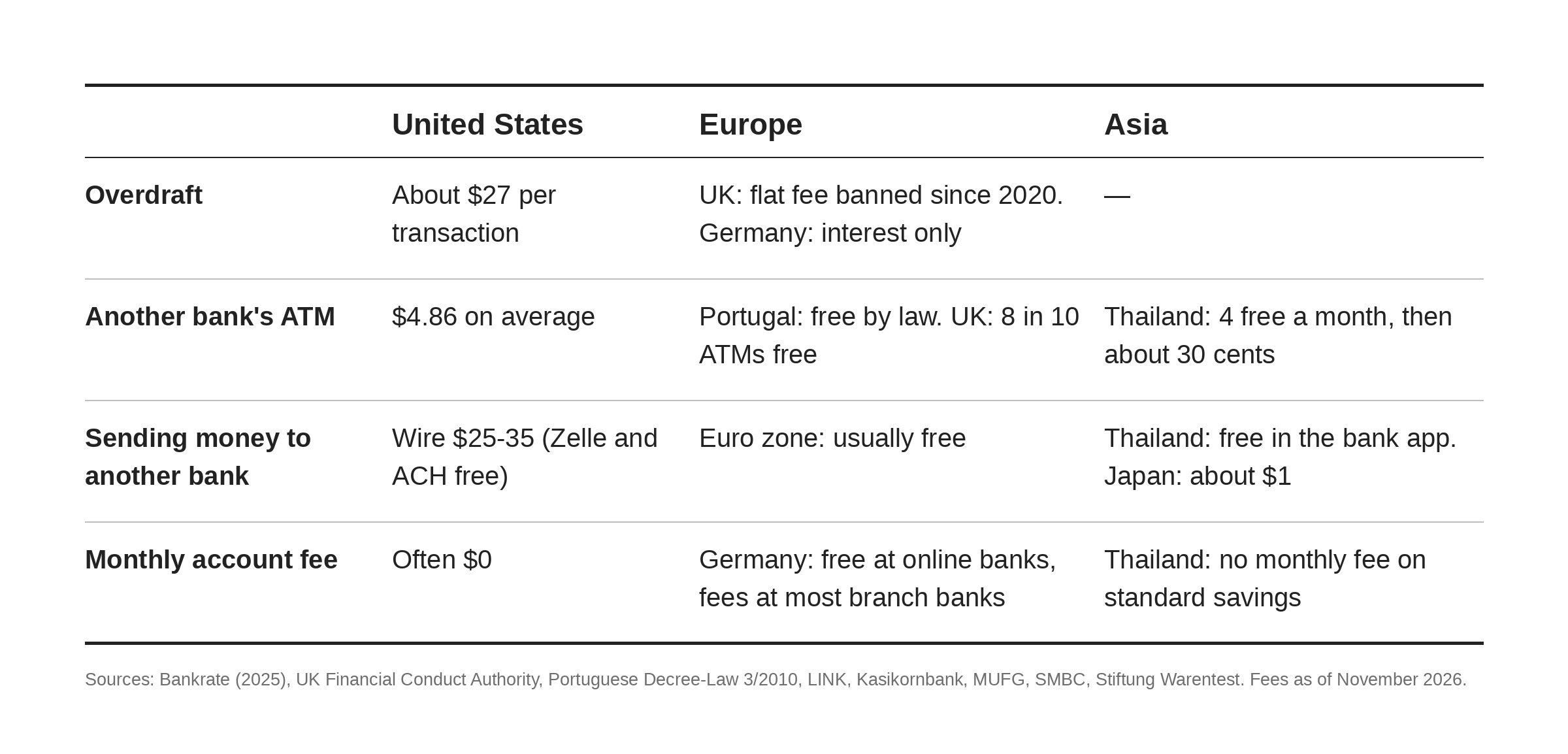
An overdraft at the average US bank costs about $27.
In the UK for example, banks haven’t been allowed to charge a flat overdraft fee since 2020.
Here’s what we’ll cover today:
How US bank fees compare with Europe and Asia
The fees you pay without ever getting a bill
5 ways to stop paying them, at home and abroad
We start with the fees you already know.
The fees you already know
Start with the penalty fees.
When your US checking account drops below zero, the bank covers the payment and charges you a flat fee for doing it.
That fee averaged $26.77 in 2025, and 94% of US checking accounts charge it (Bankrate, 2025).
In May 2025, Congress overturned a rule that would have capped it at $5 at the largest banks.
I still have my German accounts, and I have never paid an overdraft fee.
German banks charge interest on the money you borrow, and nothing per transaction.
In the UK, flat overdraft fees have been banned since 2020.
Using another bank’s machine in the US costs $4.86 on average, a record high (Bankrate, 2025).
Everyday transfers through Zelle or ACH are free in the US.
But when you need a large amount to arrive the same day, say for a house closing, you need a wire, and Chase charges $25 online and $35 in a branch.
In the euro zone, a bank transfer is usually free, and since 2025 an instant transfer can’t cost more than a standard one.
In Japan, sending money online to another bank costs ¥154 to ¥220 at the big banks (about a dollar).
Monthly fees are close to even (at least there’s that).
Most basic US checking accounts are free, or turn free once a paycheck or Social Security lands there.
In Germany, online banks are free (usually with conditions), while most branch banks charge a monthly fee.
Sending money abroad from a US bank costs more again.
An international wire costs $45 at the median (NerdWallet, 2026). Banks in between can take another $15 to $50 each.
The bank on the other end may charge to receive it too. One of my clients paid about $30 every time a wire reached her bank in Panama.
👉 Her full story is in Moving $1 Million Abroad.
About half of US credit cards charge extra when you pay abroad, usually around 3% at bank-issued cards.
A reader living in Sweden told me on a call in June:
“Now I pay 3% more for everything.”
UK banks charge about the same on their cards, so this fee is less American than the others.
👉 I covered the account setup that avoids most of this in The Full Banking Setup For Moving Abroad.
Takeaway: The US charges more than Europe or Asia when you slip up or send a wire, and about the same for simply having an account.
The fees you’ve never heard of
The most expensive fee in banking never shows up on a statement.
A business owner planning her move to Spain asked me on a call in July:
“How do you not lose money in the conversion?”
Her question inspired me to write this article, and make it free for everyone.
(Wouldn’t it be ridiculous to charge for an article about fees?).
1. The exchange rate
Every currency pair has a real exchange rate, called the “mid-market rate”.
This is the one you see when you Google “USD to EUR.”
Big banks rarely give you that rate.
They give you a worse one and keep the difference.
Chase puts it in writing. From its own fee disclosure:
“You should expect that these foreign exchange rates will be less favorable than rates quoted online or in publications.”
That’s how Chase can advertise a $0 fee on foreign-currency wires of $5,000 or more.
A $0 fee with a 3% markup is a 3% fee with better marketing.
On a $20,000 transfer, every 1% the rate is off costs you $200.
Europe forces banks to show this.
Since April 2020, EU law has required banks to show the markup on card payments and cash withdrawals in a foreign currency as a percentage above the European Central Bank’s rate, before you pay.
US rules only require your bank to show the rate it gives you and the amount that arrives.
You have to work out the markup yourself.
The check takes 10 seconds.
Google the currency pair, then compare that rate with the one your bank or app offers. The gap is your fee.
I paid this fee myself.
When my Wise account was frozen, I wired money through a transfer shop and paid nearly double what Wise would have charged.
👉 I wrote about it in 6 Money Mistakes I Made As a New Expat.
2. The question at the card terminal
Pay with a US card in Lisbon or Bangkok, and the card terminal or ATM often asks whether you want to pay in dollars or in the local currency.
Dollars feels safer (because it looks more familiar).
It is not safer.
If you choose dollars, the shop’s payment provider converts the price at its own rate, which is called “dynamic currency conversion”.
“Dynamic currency conversion” is a fancy sounding phrase, deliberately chosen to not be understood by the average consumer.
A 2017 test by the Norwegian Consumer Council found that paying this way cost 7.6% more on average and up to 12.4% more, and customers paid more in 99.7% of cases.
Always choose the local currency.
Even Schwab (which refunds ATM fees worldwide) doesn’t refund what this conversion costs you.
3. The fee for being new
ATMs abroad love charging fees to foreigners.
A US card at a Kasikornbank ATM in Thailand costs 250 baht per withdrawal on Visa and 350 baht on Mastercard, about $7 to $10 (before your own bank adds anything).
Kasikornbank’s own customers pay nothing for their first four withdrawals a month, even at other banks’ machines.
The countries you move to aren’t fee-free.
They’re fee-free once you’re a local.
4. The fee inside every price
Every time you pay by card, the store pays a fee to the banks and card networks.
In the US, those swipe fees totaled $198 billion in 2025 (Nilson Report, via the Merchants Payments Coalition), and credit cards have no federal cap.
The EU has capped these fees at 0.2% for debit cards and 0.3% for credit cards since 2015.
Australia decided in March 2026 to cut its credit card cap to 0.3% as well.
Stores pay the fee, and like rent and wages, it ends up in their prices.
Takeaway: The most expensive fees abroad hide in the exchange rate and the shelf price, so compare every rate before you convert.
5 ways to stop paying them
Let’s have a look at some actionable steps to save money.
#1 Turn off overdraft coverage on your debit card
US banks can only charge an overdraft fee on ATM withdrawals and one-time card purchases if you opted in.
Many people opted in when they opened the account without noticing.
You can opt out anytime, by phone or in the app.
A payment you can’t cover then gets declined instead of costing you about $27.
#2 Use cards that don’t charge you abroad
Schwab’s Investor Checking debit card has no foreign transaction fee and refunds ATM fees worldwide, with no limit.
That includes the newcomer fee at Thai ATMs.
The account comes linked to a Schwab brokerage account and accepts a foreign address.
For card payments, use a credit card with no foreign transaction fee.
E.g. Capital One charges none on any of its cards.
For a large wire inside the US, Fidelity charges $0.
It charges up to 3% to convert dollars into another currency, so use it for dollar wires only.
Open these accounts before you leave, while you still have a US address.
👉 I compared them in 4 US Accounts That Accept A Foreign Address.
Prefer to watch?
#3 Convert at the real exchange rate
Wise uses the mid-market rate and shows its fee before you send, usually under 1% from dollars to euros.
👉 Use it to move money and keep your savings elsewhere (Can Fintechs Really Replace Banks Abroad?).
I keep a rate alert on euros to Thai baht, which moves between 35 and 38.
When it passes 38, I convert up to €10,000 at once.
On €10,000, three extra baht per euro is 30,000 baht, about $1,000.
That’s 2 weeks of my rent.
If you send wires, send fewer and bigger ones.
#4 Always pay in the local currency
When a card terminal or ATM abroad offers to charge you in dollars, say no.
The terminal is asking whether you’d like to pay a fee.
Choose euros in Lisbon and baht in Bangkok, at shops and at ATMs.
#5 Open a local account once you’re settled
A local account removes the newcomer ATM fee for good.
In Thailand, it gets you four free withdrawals a month at other banks’ machines and free transfers in the bank app.
Most banks ask for a passport, a visa or residence permit, and a local address.
👉 I explained where this account fits in The 3 Bank Accounts Everyone Retiring Abroad Needs.
Prefer to watch?
Takeaway: Set up the right accounts before you leave, and most of these fees never reach you.
Conclusion
That’s it.
I wrote this for two reasons:
To show you what the fees you already know really cost
To show you the fees you’ve probably never heard of
Which fee surprised you most? Hit reply and tell me.
I read every answer.
Thanks for reading,
— Ben
PS: If you want an international account built for holding and moving money across borders, book a call with me here.