


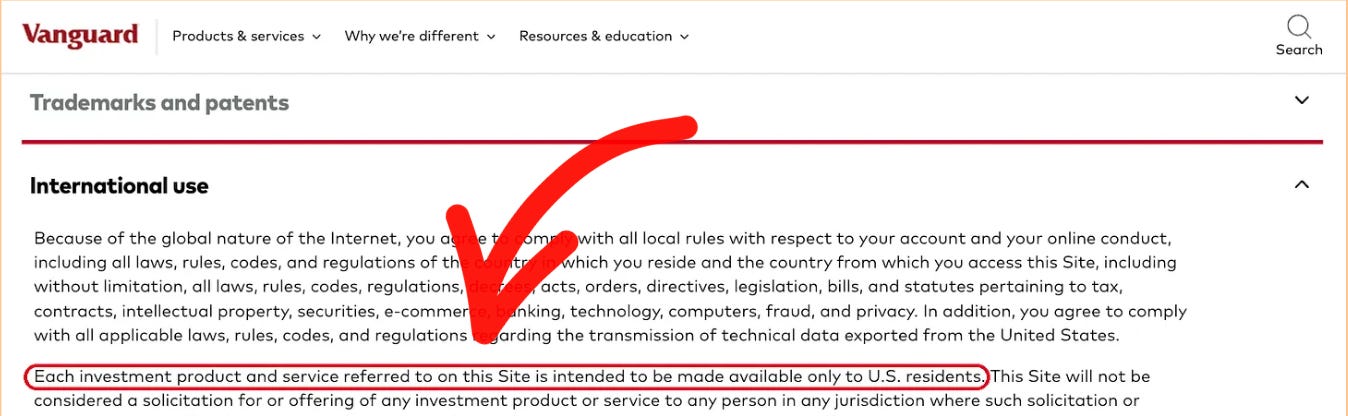
Vanguard’s terms of use say it in one sentence:
“Each investment product and service referred to on this site is intended to be made available only to U.S. residents.”
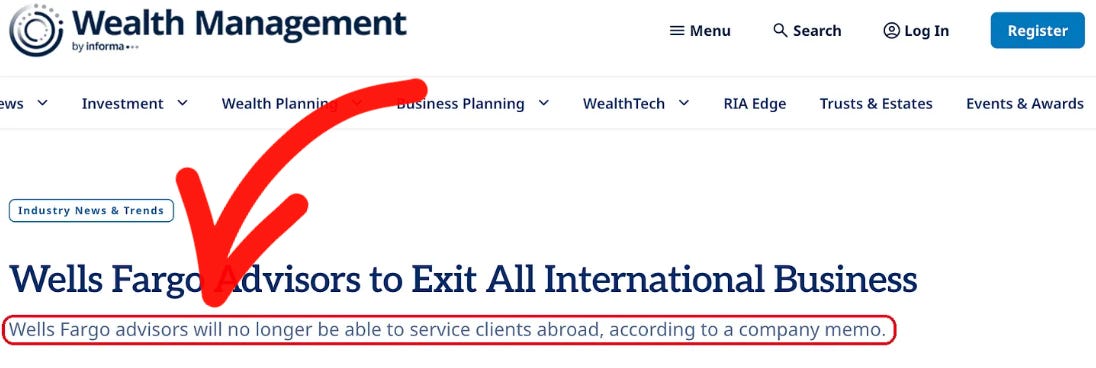
Wells Fargo went further.
In January 2021 it announced it was exiting all international business.
“Wells Fargo advisors will no longer be able to service clients abroad”
I wrote about where your wealth should be kept once you leave in The Bank Account They Can’t Touch.
Another question I get often is:
“Which US accounts can I keep?”
This article answers that question.
Here’s what we’ll cover:
What each of the four accounts does for you abroad, and what it costs
Where your money is held once you change the address
Which one to open first, depending on what you need
Let’s start.
This post is free to read.
Half of what I write here goes out to everyone, and that only works because a few hundred paid readers cover the rest.
They are the reason I can spend more time on my articles and give you as much value as possible.
If this one was useful to you, please consider joining them.
#1 Charles Schwab
Schwab has a separate international side, with a page written for Americans who live abroad.
You can open it two ways.
If you still live in the US, open a regular Schwab account now and change the address after you move.
If you already live abroad, you apply through Schwab’s international side, which asks for a passport or government ID, proof of where you live (a utility bill, a bank statement, or a mortgage statement), and your Social Security number.
What you get is a US dollar brokerage account that comes with checks and a Visa debit card.
Schwab refunds every ATM fee on cash withdrawals, anywhere in the world, and charges no foreign transaction fee when you pay in another currency.
A couple I’ve written about lives in Thailand exactly this way.

They live off ATM withdrawals from their Schwab account.
Once you use the account, remember this habit:
When a foreign ATM offers to charge you in dollars instead of the local currency, say no.
That is “dynamic currency conversion”, the machine’s own exchange rate, and Schwab’s rebate does not cover it.
And Schwab does not open accounts for residents of every country.
France and Italy don’t work.
Portugal, Spain, Greece, Mexico, Panama and Thailand all work.
Schwab doesn’t publish a list (at least I couldn’t find a reliable one, only Reddit threads, which I don’t trust enough to include here as facts), so the best way to find out is to use the dropdown menu on their website and check whether it’s possible with your destination.
Takeaway: Schwab is the account you take cash out of, anywhere, and the ATM fees come back.
#2 State Department Federal Credit Union
SDFCU is a credit union, and credit unions need a reason to let you in.
For Americans abroad the reason is membership in an association.
American Citizens Abroad charges $70 a year, and the Association of Americans Resident Overseas is the other route (I’m not affiliated here).
You join one of them, then apply to SDFCU through it.
ACA says on its own site that membership gets you the application, not an approval, and that processing takes about a week.
What makes SDFCU different is written into the application.
You can open the account with a foreign residential address.
There is no need for a US phone number, because SDFCU sends login codes over WhatsApp.
The basic checking account has no minimum balance and no monthly fee, and comes with a Visa debit card.
The card charges a fee on foreign transactions, and this is where SDFCU is less generous than Schwab.
The refund depends on how much you keep in the account:
With $2,000 in Advantage Checking, SDFCU refunds up to $15 a month in ATM and foreign transaction fees.
With $25,000 in Privilege Checking, up to $25 a month.
Both need a direct deposit of at least $200 a month, which a Social Security payment meets, and Advantage also needs ten debit card purchases a month.
Two things to remember:
The SDFCU credit cards have no annual fee and no foreign transaction fee, so for paying at a restaurant abroad the credit card is the better card.
Wise is built into SDFCU’s online banking, so you can send money to a European account without leaving the app.
Read more about Wise (and fintechs in general) below:
Takeaway: SDFCU is the US account built for a foreign address and a foreign phone number.
#3 Interactive Brokers
Schwab and SDFCU are dollar accounts.
Interactive Brokers is a broker, not a bank, and it opens accounts for people living outside the US.
You can deposit and hold up to 29 currencies in one account. A conversion costs $2 on anything up to $100,000, and cash you leave in the account earns interest.
If you move to Europe, the following happens.
Interactive Brokers moves you from its US company to Interactive Brokers Ireland, in Dublin, regulated by the Central Bank of Ireland.
You open the account under your new address, and your cash and your positions move across.
Once you are an EU resident, you can no longer buy US-listed ETFs in that account.
You can keep the ones you own, and you can sell them.
I explained why in The Full Banking Setup For Moving Abroad.
And there is no card.
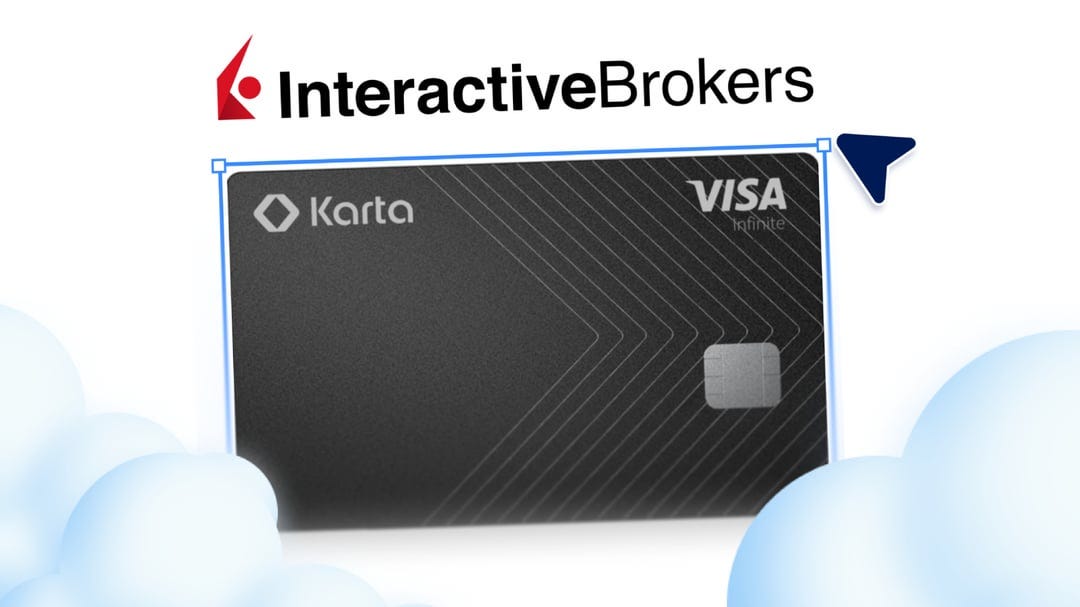
Interactive Brokers’ debit card is for US residents only, and its newer “Karta charge card” is for clients of the US company with at least $50,000 in the account.
Takeaway: Interactive Brokers holds your money in 29 currencies and takes your foreign address, but you still need one of the first two accounts to spend it.
#4 Wise
The fourth one is a fintech, not a bank.
Wise exchanges dollars into euros, or baht, or pesos, at the rate you see when you Google it.
Fees are transparent and reasonable.
People use it the following way:
Social Security arrives at Schwab or SDFCU.
You send dollars to Wise.
You convert when the rate is good (Wise lets you set an alert for that).
You pay your Portuguese rent from the euro balance.
I laid out the full mechanics in How To Move Your Money Abroad.
Open it before you leave.
Wise is easy to open with a US address and a US phone number and much harder from abroad.
Once you move, you update your country of residence, and Wise suspends the account while it reviews your proof of address, which it says takes about two days.
Also, I would keep the balances small.
Remember, Wise is not a bank.
Your dollars there have no deposit insurance unless you turn on the interest feature, and even then the cover comes through a partner bank.
I took the reasoning apart in Can Fintechs Really Replace Banks?, and the short version is:
Move money through Wise, keep two or three months of spending in it, and keep the rest somewhere safe (for example Switzerland).
Takeaway: Use Wise as a tool, not a vault. Simple as that.
Which account does which job
So what should you use which account for?
If you want cash out of any ATM in the world with the fees refunded, open Schwab.
If you want a US checking account that takes your foreign address and your foreign phone number and treats both as normal, open SDFCU.
If you are moving larger amounts between currencies, or you manage your own investments, open Interactive Brokers.
If you need to pay rent in euros from a dollar income every month, open Wise.
Most people end up with three of the four.
That is the setup I described in The 3 Bank Accounts Everyone Retiring Abroad Needs.
And whatever you do, remember this:
The best time to open these accounts is when you don’t need them yet.
Oh, and if you want to watch me talk about this topic, I recently started my YouTube channel.
You can check it out below.
Thanks for reading (and hopefully soon watching),
— Ben
PS: If you want a safe bank account outside the US, whether for investments or a safety buffer, book a call here and I’ll show you what’s possible.
GREAT post Ben. Very useful information.